
I.
The morning of December the eighth arrived at the FMP office the way certain mornings arrive in the aftermath of events that have not yet been fully absorbed: with its usual physical components—light, cold, the smell of the building’s steam heat—but without the quality of ordinariness those components typically produced. The ordinariness had been removed, and the light and cold and steam smell now existed in a different context, carrying different weight, the way the same furniture rearranged in a room produces not just a different arrangement but a different room.
Elias arrived at his usual time. He had not slept much. He did not think anyone in the building had slept much. The radio in the boarding house common room had been on until well past midnight, the landlady and two of the other tenants sitting around it in their bathrobes with the particular stillness of people receiving information they needed to hear precisely because they did not want to hear it. Elias had listened from the doorway, not going in, the broadcast’s words arriving in the hallway with enough clarity to be understood and enough distance to be, in some small way, held at arm’s length.
Hawaii. A Sunday. The Pacific Fleet.
He had gone to bed at some point and stared at the ceiling until the ceiling faded into sleep, and then he had woken before his alarm and dressed and walked to the office in the December dark with his breath making small, deliberate clouds in the cold air.
Dr. Gaines was already there when he arrived, which was unusual. The older man was standing at the window of Room Three with his hands clasped behind his back, looking at the street below with the expression of someone reading a text in a language they know imperfectly. He turned when Elias appeared in the doorway.
“You heard,” Dr. Gaines said.
“Yes,” Elias said.
There was a pause in which both men acknowledged, without discussing, the inadequacy of any available response.
“I have to make some calls this morning,” Dr. Gaines said. “To the regional offices. Some of our fieldworkers are in remote areas. I want to make sure they know.” He paused again. “I’m not sure what this means for us yet. For the program.”
“What are your concerns?” Elias asked.
Dr. Gaines looked at him with the expression of a man who has been asked to say aloud what he has been thinking and finds the prospect clarifying rather than distressing.
“Congress has never been entirely convinced of us,” he said. “Even in the better years, there were members who thought documenting folk songs was a luxury the country could not afford. In wartime—” He left the sentence unfinished. He did not need to finish it.
Elias nodded. He understood the arithmetic. A country at war organized its resources toward the war’s requirements. What could not be straightforwardly connected to those requirements became, in the calculus of wartime appropriation, vulnerable. The FMP documented folk music. Folk music was not munitions. The argument for its importance—the argument about cultural heritage, about the preservation of traditions, about the national value of knowing what its own people had sung—was not easily expressed in the language that wartime priority required.
He went to his desk. He opened the cross-reference ledger he was currently working on. He picked up his pencil.
He did not begin working immediately. He sat for a moment with the pencil in his hand, looking at the page, thinking about the word priority and what it meant to assign it, and what it meant to be the thing that was not assigned it, and how the same thing could be urgently important and entirely dispensable depending entirely on the context in which it was being evaluated.
He was familiar with this dynamic.
He had been classified, in the government’s own official language, as not acceptable for military service. He had received this designation before the country was at war, when it had meant a specific medical determination about the acuity of his right eye. Now, the morning after Pearl Harbor, it meant something that the medical language did not contain: it meant that in the primary system by which the country was about to organize the relative value of its men, he had already been placed in a category.
He began working.
II.
The weeks after Pearl Harbor moved with the particular momentum of a country that has been uncertain about something and has now received, in the worst possible form, its answer. The uncertainty was over. The question of whether America would join the war had been rendered retrospectively absurd by the fact of the war’s arrival on American soil, and the energy that had been tied up in that uncertainty—the arguing, the debating, the positioning and counter-positioning of the preceding years—had been instantly freed for other purposes.
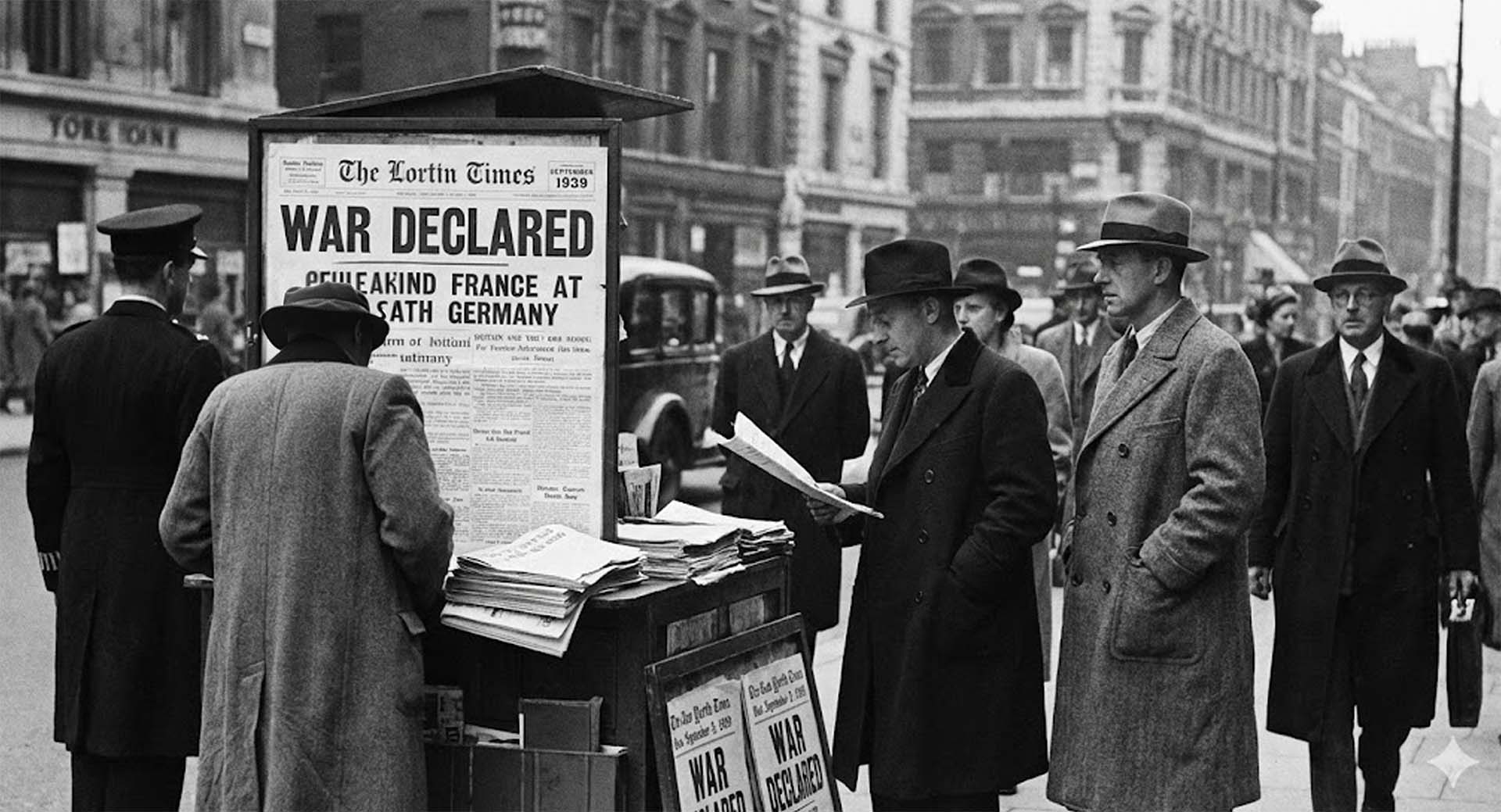
The city changed almost immediately. Elias watched it change on his walks, with the observational precision that had always been his primary relationship to the world around him. Recruiting offices appeared where other businesses had been, their windows dressed with images and slogans whose purpose was to translate the abstract obligation of patriotism into the specific, physical act of showing up at a desk and signing a form. Lines formed at those offices, longer each day, young men—and some not so young—standing in the winter cold with the expression of people who have decided something and are now waiting for the decision to be formally registered.
He walked past those lines on his way to and from the FMP office. He registered each one with the specific, uncomfortable attention of someone who is looking at something that bears on their own situation without being able to claim any part of it.
He had been classified 4-F. He had received the notice in what felt, now, like a different age—before the FMP, before the Library of Congress, before the discs and the voices and the after-hours evenings with the player running in the listening room. He had folded the notice and put it in a drawer and told himself it was information, which was true, and had attempted not to assign it meaning beyond its administrative content, which was less successfully true.
Now the notice sat in its drawer and the city stood in its lines and the meaning that he had attempted to contain had become difficult to contain because the context that gave meaning meaning had grown larger, louder, and more insistent in every direction.
He was not a man prone to self-pity, which he distinguished carefully from self-knowledge. Self-pity was the error of treating accurate information about oneself as a wound that could be nursed. Self-knowledge was the discipline of treating accurate information about oneself as a tool, useful insofar as it was applied correctly and useless insofar as it was merely contemplated. He applied this distinction as best he could to the 4-F notice, to the lines at the recruiting offices, to the mornings in the FMP office as December became January became February and the composition of the rooms around him began, gradually and then with accelerating momentum, to change.
III.
Peter Sloane received his notice in January.
He brought it to the office in a state that was not quite the state of a man who had expected the news and not quite the state of a man who had not expected it—somewhere between, the state of a man who had known the news was coming and had nonetheless been startled when it arrived, the way one is startled by a loud sound that one has been told will occur at an indeterminate moment.
He held the notice in his hand, standing in the middle of Room One, and announced it with the directness that characterized everything he did: “I’ve been drafted. February the second. Army.”
The room responded in the various ways rooms respond to such announcements. Howard’s replacement—a clerk named Brindle who had been with them three months—looked up briefly and back down, performing a kind of tactful distance that was perhaps his most useful quality. Dr. Gaines, who had appeared in the doorway of Room Three at the sound of the announcement, received the news with the expression of a man adding it to a ledger he had been keeping in his head for weeks. Ruth, who was in Washington between field trips, stood up from her desk and crossed the room and put her hand briefly on Peter’s arm and said nothing, which was, given her usual directness, a form of eloquence.
Elias said: “When do you leave?”
“February second,” Peter said again. Then, hearing the redundancy, he laughed—a short, slightly unsteady laugh that was more a release of tension than an expression of amusement. “I keep saying that. As if the date is the most important part.”
“Are you prepared?” Elias asked.
“I have no idea,” Peter said. “I know how to move through a community I’ve never been to before and make people trust me enough to sing into a microphone. I’m not sure how applicable that is.”
“More than you’d think,” Ruth said. It was the first thing she’d said, and it settled in the room with the weight of an observation from someone who knew something about navigating unfamiliar territory.
In the days that followed Peter’s announcement, Elias found himself in a revised relationship to the man’s characteristic habits—the disorganized field notes, the breathless accounts of communities and voices, the restless enthusiasm that made him difficult to work with and essential to be around. He documented them, in the private ledger, with a care he recognized as the care one takes with things in the process of becoming past tense.
He helped Peter organize his most recent field materials, the Carolinas collection, so that it would be properly integrated before he left. He did this without being asked, and Peter accepted it without making it into something it didn’t need to be, which was, Elias thought, one of Peter’s consistently decent qualities.
On Peter’s last day in the office, they worked side by side through the afternoon, and at the end of the afternoon Peter stood and put on his coat and picked up his bag and paused at the door.
“The Virginia trip,” he said.
“Yes,” Elias said.
Peter had mentioned it twice in the months since proposing it—once in passing, once more directly, with the persistence of someone who believes that the right moment for a thing is simply the next available moment. Elias had continued to deflect, with the honest acknowledgment that he would consider it, which had remained, through the fall and into the winter, exactly that: a thing being considered.
“You should have come,” Peter said. Not with accusation—with the plain statement of someone reporting a conclusion he has reached.
“I know,” Elias said.
Peter looked at him for a moment with the specific attention he gave to interesting problems in the field—the quality of engagement that Elias had come to associate with Peter at his most serious.
“You hear things in those rooms that don’t make it onto the disc,” Peter said. “The context. The way the room changes when someone starts singing. The way other people in the room listen.” He paused. “You would have been good at that part. The listening.”
Elias said nothing. The compliment—if it was a compliment, and it was delivered without quite enough inflection to be certain—lodged somewhere in the space behind his sternum where the private ledger was kept.
“Take care of the materials,” Peter said.
“I always do,” Elias said.
Peter left. The door closed. Room One adjusted to his absence in the way rooms adjust to any significant departure: the same dimensions, the same objects, but the space he had occupied now technically available and functionally hollow for some time afterward.
Elias sat at his desk and looked at the integrated Carolinas entries in their new binder—Peter’s field notes organized, cross-referenced, properly filed—and thought about what Peter had said: You would have been good at that part. The listening.
He had been listening, he thought. In his way. In the Library, in the evenings, with the discs. With the voice in the disc that he still returned to, more regularly now than he would readily have admitted to anyone who might ask.
He was not sure, and had not been sure since Peter first proposed the Virginia trip, whether the listening he did in a room with old recordings was the same kind of listening that the field required. He suspected it was related. He was less certain it was equivalent.
He sharpened his pencil and returned to the integration work.
IV.
Franklin Osei left in March.
He had been among the men whom Elias had assumed might face complications with the draft—the armed forces were segregated, and the specific mechanisms by which the country processed the service of Black men were, to put it precisely, not the same mechanisms it applied to others. But Franklin, who had grown up in Georgia and had spent his professional life moving through the spaces between what was formally possible and what was actually possible, navigated those mechanisms with the same quiet, capable authority he brought to everything.
He did not receive a draft notice in the ordinary way. He enlisted. He walked into the relevant recruiting office on a Tuesday morning in March and, by a process that involved patience and persistence and the specific, practiced combination of dignity and practicality that the era required of him, secured a position in a unit whose designation Elias did not know and would not ask about. He told the office on a Wednesday. He left the following Monday.
His departure was the one that affected Elias most unexpectedly.
He had known Franklin for less than a year, and their relationship had been primarily professional—Franklin bringing materials from his field trips, Elias organizing them, the two occasionally talking in the margins of this exchange about the work itself. But Franklin’s way of talking about the work had given Elias more than he’d received from most conversations: a consistent, grounded reminder that the music being documented was not merely cultural artifact but living practice, not merely history but present tense, not merely interesting to study but necessary to the communities that carried it.
Franklin had said, once, standing in Room Two while Elias played a disc from a Mississippi church group: “My grandmother sang that.” Not that song specifically, he’d clarified, when Elias had looked up. But that tradition. That specific relationship between the call and the response, that way the voices found each other in harmony without being told where to go.
The statement had stayed with Elias because it was evidence of something his professional engagement with the materials sometimes obscured: that the recordings were not orphans. They had families. The voices in the discs were not abstractions or specimens or historical data but the voices of specific people who had grandchildren, and the grandchildren were real, and the connection between the voice in the disc and the living person in the room was continuous rather than broken, and the archive’s job was to honor that continuity rather than to substitute for it.
He thought about this more after Franklin left. He thought about it while cataloging, while cross-referencing, while sitting in the listening room in the evenings with the disc from Box 9 on the player.
The voice on that disc also had continuity. Had a family, presumably. Had a history that extended beyond the two-and-a-half minutes of the recording. The partial name on the label—”Dallas—” and the smear and the possible “Lee”—was the name of a real person who had existed in the world beyond the disc’s groove, who had walked through spaces and eaten meals and spoken words that the recording could not contain.
He was preserving two-and-a-half minutes of that person.
It was not enough. It was never going to be enough. But it was what the technology allowed and the circumstance had produced, and he had spent enough time in the Archive to understand that two-and-a-half minutes, handled with care, could carry more of a person across time than a thousand well-intentioned but poorly preserved hours.
He handled the disc with this in mind.
V.
The summer of 1942 brought with it the Congressional debates that Dr. Gaines had anticipated on the morning after Pearl Harbor.
They arrived, as Congressional debates tend to arrive, through the medium of newspaper coverage, which Elias followed with the attentiveness of someone who understood that what was being discussed was not abstract policy but the specific continuation or non-continuation of the building he sat in every day. The WPA had, by the standards of the New Deal’s programs, survived longer than many—it had outlasted the Federal Writers’ Project and the Federal Theatre Project, which Congress had defunded in 1939 with the specific hostility that certain members of the legislature reserved for programs that could be accused of political or cultural ambition.
The FMP had survived that round of cuts in modified form, emerging as a program with reduced federal oversight and increased state administration, its budget trimmed, its ambitions tempered. This had been a compromise that preserved the essential work at the cost of the scale and coordination that had made it most effective. Dr. Gaines had accepted it with the stoicism of a man who understood that partial preservation was better than total loss and who did not waste energy mourning the difference.
Now, in 1942, the debates were different in character. The earlier arguments had been about cost and political ideology—whether the federal government should be funding artists and researchers at all, whether the WPA’s programs were extravagant or socialist or simply unnecessary. The new arguments had the advantage, from Congress’s perspective, of being harder to rebut: the country was at war, unemployment had essentially ceased to exist as a social problem because the war industries had absorbed the workforce, and the original justification for the WPA—that it existed to put people to work who could not otherwise find work—had been rendered obsolete by circumstances.
Elias could not dispute the logic, though he found it incomplete. The logic addressed the WPA’s economic function and left untouched its cultural one—the function of documenting, preserving, and making accessible the folk traditions that the fieldworkers had been gathering since 1935. Congress did not appear, by the evidence of the newspaper coverage, to find the cultural function a compelling counterargument to the economic one.
Dr. Gaines called the office together in October—a meeting that included the remaining field staff, two of whom were in Washington at the time, and the administrative staff, which was by then reduced to Elias and a part-time clerk—and delivered the situation plainly.
“Congress is moving toward dissolution of the WPA,” he said. “The timeline is uncertain, but I believe it will happen in the next year. When it does, our position under the WPA ends with it. The materials we have collected will be transferred to the Library of Congress and other appropriate institutions. The fieldwork will stop. The documentation work will continue in some form, under different auspices, but our specific program—this office, these positions—will not survive.”
He said this without visible distress, which Elias admired in a way that had nothing to do with agreement. The news warranted distress. Dr. Gaines declined to provide it on behalf of a Congress that had already decided.
“What happens to the collections?” Elias asked.
“The Archive of American Folk Song will absorb most of what we have,” Dr. Gaines said. “Fessler has been preparing for this. The materials will be preserved.” He paused. “That was always the point.”
Ruth, who was present, said: “And us?”
“You will find other work,” Dr. Gaines said. “The skills this program has required are real. The war has created needs—documentation, research, materials management, cultural liaison work in various theaters—that I believe will provide opportunities for people with relevant experience.”
He did not look at Elias when he said this, which was a kindness rather than a slight. The skills Dr. Gaines was describing were the fieldworkers’ skills—the skills of people who went places and observed things and talked to communities and produced materials from those engagements. Elias’s skills were different. Elias’s skills were the skills of someone who organized what other people brought back.
Those skills were useful. They were perhaps less obviously transferable to the kinds of work the wartime government was generating.
He walked home from that meeting through the October evening, which was cold and clean in the specific way of Washington autumn—the air stripped of summer’s haze by the first serious fronts of the season, the light lower and more angular, the city’s monuments casting longer shadows. He walked and did not make a list of options, which was unlike him. He walked and thought about the voice on the disc in Box 9, which was, he recognized, not a response to the problem at hand but a retreat into the thing that the problem was threatening to take from him.
He thought: when the program ends, I will no longer have access to the Archive’s listening room.
He thought: the disc will still be there, properly cataloged and integrated, accessible to any researcher with a legitimate purpose who requests it through the proper channels.
He thought: I am not sure those two things are equivalent.
He was aware that this distinction was not professional. He was aware that the attachment he had developed to a recording in an archive was not something he could defend in any of the vocabularies available to him—not the professional vocabulary of archival work, not the personal vocabulary of his boarding house room with its harmonica and its photograph. It existed in some other register, one he had not previously needed to name because he had not previously experienced anything that required it.
He let himself into the boarding house, climbed the stairs, and sat at his desk in the particular way he sat when he was not going to immediately do anything—hands flat on the surface, back straight, the posture of a man holding himself in position until the moment for action clarified.
On the bookcase, the harmonica sat in its usual place, to the right of the books and to the left of his father’s wooden box, unchanged and unchanged and unchanged.
VI.
Thomas Graves left in November.
He was forty-four, which was beyond the ordinary draft age for most categories, but Thomas had arranged it himself. He had spent two months in correspondence with the Office of War Information, which was looking for people with exactly the skills he possessed—an ability to move through unfamiliar communities, to document and transmit what he found, to understand cultural contexts quickly and communicate them to those who needed the information.
He told Elias about it over coffee in the building’s small breakroom, on a gray November morning with rain on the windows.
“Field documentation,” Thomas said. “Just in different fields.”
“Where?” Elias asked.
“North Africa, initially. Then wherever they send me.” He said this with the quiet, settled authority that characterized his assessments of most things—not bravado, not resignation, but the specific calm of a man who has made a considered decision and has stopped deliberating.
Elias looked at his coffee.
“You could make a case,” Thomas said, after a moment, “that what we’ve been doing here is as important as what I’m going to do there.”
“I know you believe that,” Elias said. “I’m not certain Congress shares the view.”
“Congress is not always the correct institution to consult on questions of value,” Thomas said.
Elias didn’t answer. He thought about what it would feel like to be the kind of person who could say that—not as a complaint, but as a plain statement of philosophical position, delivered without bitterness or self-justification, secure enough in one’s own assessment to make it without the backing of official sanction.
“The 4-F,” Thomas said. He said it not as a question, but as a topic being opened.
Elias looked up.
“It’s a medical determination,” Thomas said. “It describes a condition of one eye. It does not describe a person.”
“People are treating it as a description of a person,” Elias said. He said it more plainly than he had said most things on the subject, which he had avoided saying to anyone. He said it with the specific quiet of someone who has been holding a statement for a long time and has decided, for reasons he can’t entirely articulate, that this particular moment and this particular person are sufficient grounds for its release.
“Yes,” Thomas said. “They often will. People organize their assessments of others around available categories. The available categories right now are very clear, and they favor certain kinds of men.” He paused. “I’ve watched you work for eight months. You are the reason the Texas collection is retrievable. You are the reason the Carolinas materials will be useful to whoever comes after us. That is real work. It has a different relationship to danger than what I’m going to do. It is not a lesser relationship to value.”
Elias said nothing.
“Keep the work,” Thomas said. “Whatever happens to the program. The work is larger than the program.”
They finished their coffee. Thomas stood, shook Elias’s hand with the firm, specific grip of a man who means the handshake to carry more than the handshake can technically hold, and went back to Room Three to continue the preparations for his departure.
Elias returned to his desk.
He sat with Thomas’s words in the private ledger: The work is larger than the program.
He had known this, in some form. He had believed it without quite believing it, the way one believes things that one has not yet had occasion to test. Thomas had simply said it aloud, which was different.
He picked up his pencil.
VII.
The WPA was formally dissolved by act of Congress in June of 1943.
The debate had extended through the winter and spring in the newspapers and in the government corridors, its outcome never seriously in doubt but its terms fought over with the ritualized energy of an argument whose conclusion is known but whose record matters. The final vote was not close. The country was fully employed by the war. The emergency the WPA had been created to address was, by the measures Congress applied, over.
The Federal Music Project—already much reduced from its 1935 form, operating on budgets that bore little resemblance to the program’s peak years, its fieldwork substantially curtailed and its staff largely departed to war service or other employment—ceased to exist as an official entity on June the twenty-ninth.
Elias received the formal notice of his position’s termination on a Tuesday morning, in an envelope from the WPA’s administrative office, in the same format in which all such notices were delivered: official stationery, bureaucratic language, thirty days.
Dr. Gaines had known it was coming. The whole office had known it was coming. Knowing did not prevent the notice from having its particular weight—the specific gravity of a document that describes a change in one’s status in the world, however expected the change may be.
He sat at his desk and read the notice twice. Then he folded it and placed it in his coat pocket and returned to the work on his desk, which was the final stage of the integration project—the last of the unprocessed materials being entered into the cross-reference system before the FMP’s files were transferred to the Archive and the institutional affiliation that had given him access to them ceased to exist.
He worked through the morning and into the afternoon with a focused efficiency that was, he knew, a form of postponement. When the work was done, the notice would be the primary fact of the day. As long as the work was not done, the notice remained secondary.
Dr. Gaines came to his desk at three in the afternoon and stood for a moment watching him work—not interrupting, not commenting, simply present in the way that people who have spent years in proximity to someone’s work are sometimes simply present before they speak.
“The Library will need someone for the summer,” Dr. Gaines said finally. “Fessler has asked. The transfer of our materials will require documentation, and he has limited staff. It isn’t a permanent position. But it would see you through until something else clarifies.”
Elias looked up.
“He specifically asked for you,” Dr. Gaines said. “By name. He said, and I’m quoting, ‘Thorne knows where everything is.'”
The phrase, borrowed from Elias’s own assessment of Fessler on their first meeting and now returned to him from the other direction, produced in him a feeling he didn’t immediately identify. He identified it, after a moment, as the specific warmth of being known—not generally, not impressionistically, but specifically: for the particular thing one actually did, rather than for a set of qualities that had little to do with what one spent one’s days on.
“I’ll speak to Fessler,” he said.
“Good,” Dr. Gaines said. He paused. Then, in a tone that acknowledged both the inadequacy of the available language and the genuine intention behind it: “This program mattered, Thorne. What you did in it mattered. The records will outlast all of us.”
He went back to Room Three.
Elias sat for a moment with that sentence, and then, because the work was still unfinished and the final transfer integration required his attention, he picked up his pencil and returned to the last of the entries.
VIII.
The office emptied over the final weeks of June.
The FMP’s physical materials—the discs, the reels, the field notes, the correspondence, the working catalogues and indices and cross-reference files—were packed into the same kind of flat boxes and wooden crates they had arrived in, and were transported to the Library in stages, each box carrying its labels in the system that Elias had built and rebuilt over eighteen months of sustained organizational effort. The shelves of Room Two became visible again as the rows of sleeves and boxes diminished, the bare wood of the shelving units emerging from behind the collection like walls revealed when furniture is moved.
Room One shrank to a desk, a chair, and the blackboard with its permanent chalk instruction—”FIELD NOTES: CROSS-REF BEFORE FILING”—which no one had erased because no one had felt it was their responsibility and now sat there as a kind of epitaph, a reminder that the processes it had described were over.
On the last day, Elias was the last one out.
He had arranged it without quite intending to, arriving early and working late while the others cleared their desks and collected their things and said their goodbyes. Dr. Gaines had left at mid-afternoon with a handshake and the specific brevity of a man for whom ceremony was a kind of sentiment and sentiment was not something he deployed freely. Ruth had hugged him, briefly and entirely without self-consciousness, and left with the air of someone who already knew where she was going next, which she was. Even Brindle had shaken his hand.
He stayed behind to complete the final inventory—a list of what had been transferred to the Library and what remained, if anything remained, to be transferred. He found, in the course of this inventory, that everything was accounted for. Every disc, every reel, every field note, every photograph. Eighteen months of meticulous work had produced a complete and accurately described transfer with no orphaned materials and no discrepancies.
He wrote “Transfer complete – no remaining items” at the bottom of the final inventory sheet and signed it and dated it: June 29, 1943.
Then he looked around the room.
The desks were cleared. The shelves were bare. The blackboard instruction remained. Through the window, Pennsylvania Avenue conducted its afternoon business with its usual indifference to the status of the rooms above it.
He put on his coat. He picked up his satchel, which contained his notebook and his pencil case and the documentation forms he had brought in the habit of professional preparedness, though there was nothing left to document.
He turned off the light.
He walked down the stairs and out the building’s door and onto the street, and the door swung shut behind him, and the program was over, and he was thirty-three years old and out of work for the first time since the worst years of the Depression, and the city moved around him in its ordinary Friday afternoon way.
He stood on the sidewalk for a moment.
He thought of Peter Sloane somewhere in a theater of war, moving through communities with a different kind of equipment and a different set of stakes. He thought of Franklin Osei in whatever unit he had joined, applying his patience and his authority to circumstances that Elias could not fully imagine and that the news from North Africa described in terms that made imagination feel both necessary and impossible. He thought of Thomas Graves in some field somewhere, documenting what he found, as he had always done.
He thought of Ruth, already en route to her next project, already making arrangements with the specific, competent urgency of someone for whom the end of one thing was simply the beginning of the logistics of the next.
He thought of his 4-F notice, still in its drawer at the boarding house, under Cost Accounting Principles and the pencil case.
He thought: I am the one who stayed.
He walked.
He walked past Delroy’s barbershop—closed for the afternoon—and past the boarding house, which he did not enter yet because he was not ready to be in a room alone with the day’s fact, and past the street where the WPA recruiting office had been and was now a tailor’s shop again, and past the park where he occasionally ate his lunch in warm weather when he had remembered to bring it.
He walked until the particular quality of his walking—the forward motion of a man who does not yet have a destination—shifted into the forward motion of a man who has found one without consciously choosing it, and then he looked up and saw, with a clarity that was partly geographical and partly something else, that he was on the street that led to the Library of Congress.
It was not a workday. He had no position. The Library’s staff would have no reason to admit him to the Archive or to the listening room.
Fessler had given him a key, which he had not returned, which he had not been asked to return, which resided in his coat pocket with the quiet permanence of something that has been so long in a place that it has ceased to be noticed.
He did not go in. Not that day. He stood on the street and looked at the building with the feeling of a man who has been traveling for a long time and has arrived at a place he cannot, technically, yet enter.
He turned and walked home.
In his room, he sat at his desk and opened his notebook to a fresh page and dated it: “June 29, 1943.”
Beneath the date, he wrote: “Position ended. Transfer complete. The collection is intact.”
He paused for a long time. Then he wrote: “Begin again. From here.”
He put the notebook down.
On the bookcase, the harmonica sat unchanged.
Outside, the evening gathered over Washington with its usual combination of the particular and the generic—this city, this evening, these sounds, this summer’s end—and Elias Thorne sat at his desk in a rented room and thought about voices in wax and voices in shellac and a partial name on a label that had bothered him, in the best possible way, for almost a year now, and about what it meant to be the person who stayed behind to make sure those voices could be found.
He thought it meant something. He was not yet sure what.
He was going to find out.
