
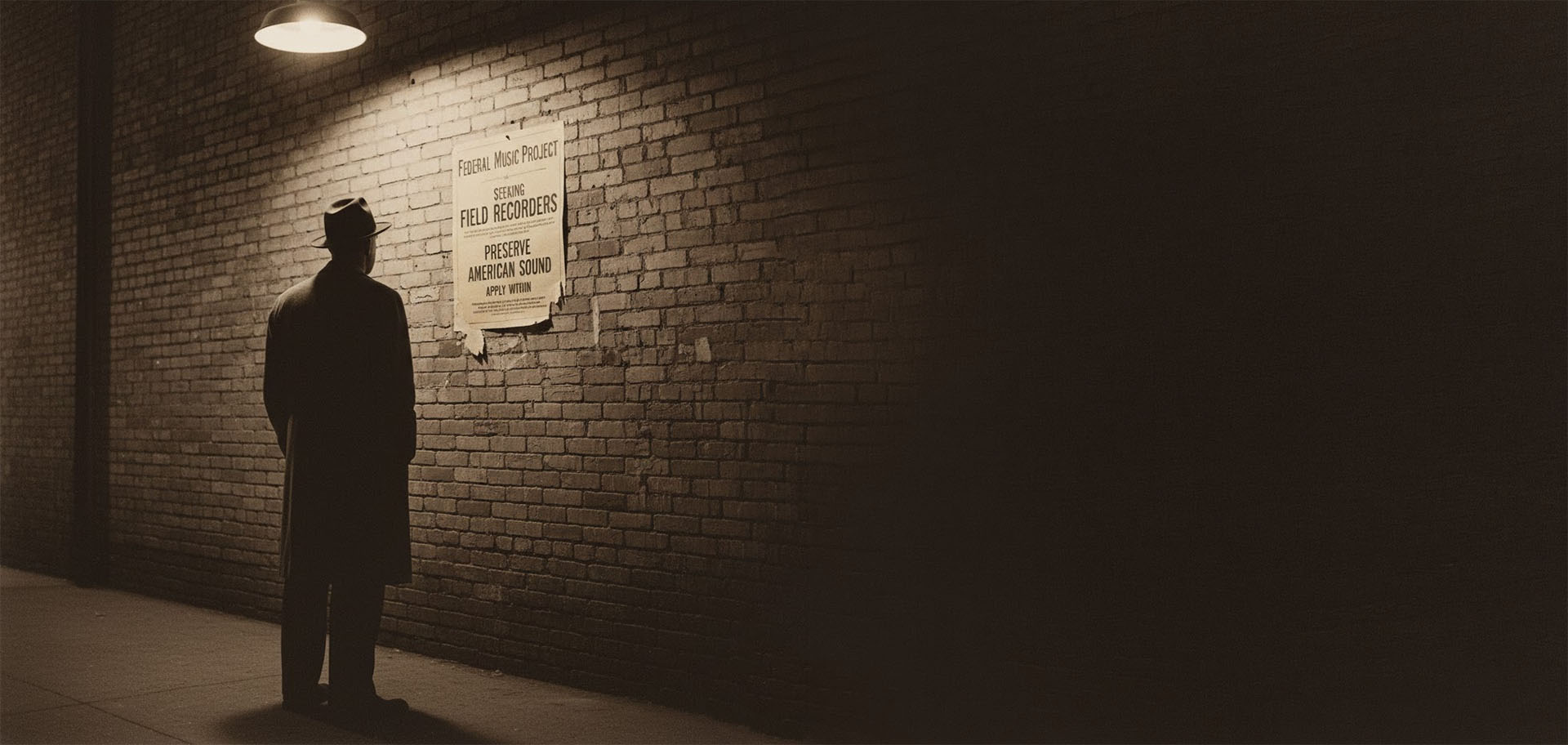
I.
The letter took him four drafts.
He was not generally a man who revised. His professional correspondence—the memos and notices and brief cover letters that circulated through Barfield & Associates like the lesser paperwork of a functioning office—he produced in single passes, with the same untroubled accuracy that characterized his column entries. He knew what he wanted to say, and he said it, and the saying required no particular renegotiation between intent and execution.
The letter to the Federal Music Project was different.
The first draft was too formal, even by his own standards—a document so scrupulously organized that it read less like an application and more like a memorandum submitted to a superior by a subordinate who expected to be audited. He read it back and heard, in its rigid paragraphs, the sound of a man apologizing for his own interest before anyone had questioned it. He set it aside.
The second draft overcorrected. He had attempted to write with more warmth, which in his case produced something that read like warmth being performed by a person who had read about warmth in a manual. He used the word “passion” once and then looked at it for a full minute before crossing the whole paragraph out. He did not use that word again.
The third draft was closer. He described his experience honestly—the three years at Barfield, the bookkeeping certifications, the accounting background—and then allowed himself, cautiously, a paragraph that explained what had drawn him to the posting. He wrote about the trade journal article, about his understanding of the FMP’s mission as the systematic preservation of musical traditions that existed primarily in oral and performance form. He wrote, with the kind of careful plainness that was his best available substitute for eloquence, that he believed the work of cataloging and organizing field recordings to be a form of service to exactly those communities whose music was, by its very nature, in danger of being lost.
He read this paragraph back and thought that it was probably true, and that true was better than elegant.
Then he rewrote it once more, in the fourth draft, because the third had mentioned his accounting background four times in the first two paragraphs, and he could hear, even in the silence of his room, the sound of a man who did not quite believe he had anything to offer except numbers.
He posted the fourth draft on a Monday morning in early December of 1941, on his way to Barfield. Three days later, Pearl Harbor happened, and for a period he thought the letter had been rendered irrelevant by a world that had found more urgent things to administer than folk songs.
He was wrong about this, though it took six weeks for the evidence to arrive.
The response came on a Tuesday in late January 1942: a single sheet of government stationery, addressed to “Mr. E. Thorne,” inviting him to attend an interview at the WPA offices on the twelfth of February at two in the afternoon. The letter was signed by a Dr. Harold Gaines, identified as the FMP’s Regional Documentation Coordinator, and its prose was the standard variety of institutional correspondence—neither warm nor cold, informative without being committal.
He read it standing at the bottom of the stairs in the rooming house, having taken it from the landlady’s hand, and the precision of his self-control was such that he simply nodded and thanked her and climbed the stairs before permitting himself any reaction at all. In his room, with the door closed, he sat on the edge of the bed and looked at the wall for a moment.
Then he took out his notebook and began to prepare.
II.
The WPA offices occupied a floor of a building three blocks from the Ellipse, in a space that had the characteristic atmosphere of federal administration: a democracy of beige walls and institutional carpeting, the smell of paper both old and new, the particular quality of lighting that government buildings achieved through the combination of inadequate windows and fluorescent supplements. The carpeting had been installed early in the New Deal years and had since developed the compressed, durable quality of something that had been heavily trafficked by people who did not have time to consider whether they were damaging it.
Elias arrived seven minutes early, which was, for him, slightly late. He had aimed for ten minutes early and lost three of them to a redirected bus. He gave his name to a clerk at a reception desk and sat in one of the waiting chairs with his notebook on his knee—not open, just present, a physical reminder of the preparation inside it.
The corridor outside the relevant office was populated, at intervals, by people who did not look like accounting clerks. He noticed this immediately, with the observational reflex that had been cataloging rooms and their contents since he was old enough to register difference. A woman in her thirties sat two chairs to his left, wearing practical clothes—heavy cotton, sensible shoes—and reading a journal that he recognized, after a moment, as the same publication in which he had found the article that had led him here. She read with the engaged speed of someone for whom the content was not background material but active professional concern.
A man across the corridor—younger, perhaps twenty-five, with the kind of physical ease that came from spending time outdoors rather than at a desk—was talking in a low voice to another man beside him, gesturing occasionally in a way that suggested he was describing a place rather than a concept. He wore, on his wrist, a band of skin noticeably lighter in color than the surrounding skin, as if a watchband had been recently absent—the mark of a man who had been in a different climate not long ago, where sun had reached his wrists while the band protected the skin beneath.
A fieldworker, Elias thought. Someone who had actually gone.
He looked at his own wrists. Even in color. Indoors all winter.
He opened his notebook.
Dr. Harold Gaines proved to be a man in his fifties, compact and specific in his movements, with wire-rimmed spectacles and the manner of someone who had conducted a great many interviews and had long since developed an efficient protocol for extracting useful information without performing engagement he didn’t feel. He shook Elias’s hand, indicated a chair, sat, and opened a folder on the desk between them.
“Your letter mentioned the Resettlement Administration article,” he said. No preamble, no warmup.
“Yes,” Elias said.
“What drew you to that in particular?” Dr. Gaines asked, looking at the folder rather than at Elias. “We receive applications from musicians, from academics, occasionally from journalists. Accountants are less common.”
“I understand the need for documentation to outlast the documenter,” Elias said. This was from the fourth draft. He had kept it because it was true. “The fieldworker goes to the community, makes the recording, and returns. What happens to the recording afterward determines whether the trip was worthwhile. My background is in making things that have happened afterward-worthy.”
Dr. Gaines looked up.
It was not a dramatic look—not the look of a man struck by revelation. It was the look of a man who has been doing his job long enough to recognize, when he hears it, the difference between a prepared answer and an actual idea.
“Afterward-worthy,” he repeated.
“The recording exists,” Elias said. “But until it has been cataloged correctly, described accurately, and filed in a manner that allows it to be found by someone who needs it, it is not yet useful. A misfiled recording is functionally the same as a recording that was never made.”
He had thought this himself, many times over the six weeks since mailing the letter. He had not borrowed it from anyone. He delivered it now with the certainty of a man recounting a personal conviction rather than demonstrating a learned position.
Dr. Gaines made a small mark in the folder.
“Your accounting background,” he said. “You understand double-entry systems, reconciliation, cross-referencing.”
“Yes.”
“We have—” He paused, chose a word. “Accumulated rather a great deal.”
Elias waited.
“The fieldworkers are extraordinary at what they do,” Dr. Gaines continued. “They go into communities that have never had a government visitor before and come back with songs that have been sung the same way for a hundred and fifty years. They are dedicated, skilled, and in several cases genuinely brave.” He said this with the particular tone of a man paying tribute to virtues he admired but did not share. “They are somewhat less extraordinary at paperwork.”
Elias had understood this from the article, which had described, in diplomatically indirect language, the challenge of managing the volume of materials that the FMP’s fieldwork was generating. He had understood it as an opportunity. He understood it now as a job description.
“When can you start?” Dr. Gaines asked.
Elias thought of his letter of resignation from Barfield, already drafted and waiting in his desk drawer. He had drafted it two weeks after sending the FMP letter, on the theory that preparing for an outcome was not the same as presuming it.
“Two weeks from today,” he said.
Dr. Gaines nodded, closed the folder, and stood.
It was, Elias reflected on the walk home, the most efficient significant conversation of his life.
III.
The FMP’s documentation office occupied four rooms on the third floor of a building on Pennsylvania Avenue, in a suite that had originally been intended for a regulatory sub-commission that had been reorganized out of existence before it ever fully organized itself into existence in the first place. The rooms had been reassigned to the FMP with the brusque efficiency of a federal bureaucracy that dealt in floor space rather than suitability, and the result was a workspace that made no particular concessions to the nature of its occupants’ work.
Room One was the main office: six desks arranged in two rows, filing cabinets along the far wall, a blackboard on which someone had written, in large chalk letters, “FIELD NOTES: CROSS-REF BEFORE FILING” and then never erased it, so that it had become simply part of the room, like the water stain near the window and the clock that ran four minutes fast. This was where the administrative staff worked—three clerks on loan from the broader WPA machinery, rotated periodically, rarely there long enough to learn the specific vocabulary of the project.
Room Two was the listening room. Two disc players, a reel machine that had arrived in the previous year and was treated with the reverence due a foreign dignitary of uncertain temperament, and shelves that covered three walls from floor to near-ceiling, filled with disc sleeves and flat boxes. The room smelled of shellac and dust and a faint metallic undertone that Elias would later learn to associate with acetate blanks stored too long without playing. He stood in the doorway of Room Two on his first morning and looked at the shelves the way a man might look at a territory he had not yet charted but has been waiting, without knowing it, to be given.
Room Three was Dr. Gaines’s office, which also served as the project’s primary consultation space and contained, beside the desk and chair and regulation bookcase, a folding table that was perpetually covered with maps—state maps, county maps, detailed topographic maps of rural areas annotated in various hands with locations, dates, and the occasional cryptic notation that only the annotator could decode.
Room Four was less a room than a former storage closet that had been press-ganged into service as the space where new materials were held before processing. It was always full. It was always, by the standards of the rest of the office, chaotic—boxes stacked without system, disc sleeves loose among reel containers, field notes folded into whatever space was available rather than filed by any organizing principle. It was the space where Elias would spend most of his first three months.
He was given a desk in Room One, between a clerk named Howard who processed invoices without apparent interest in their content and a filing cabinet that had been commandeered as a surface for stacking things that didn’t have another home. The desk was smaller than his desk at Barfield, with a leg that was slightly shorter than the other three, requiring a folded piece of cardboard under the short leg to prevent the surface from rocking. He found the cardboard in Room Four on his second day and installed it himself, without mentioning it to anyone.
Dr. Gaines introduced him to the room on the first morning with the brisk efficiency of a man who trusted the introduction to convey what was necessary and no more: “This is Elias Thorne. He’s here to help us make the collection useful. Show him what needs doing.”
What needed doing was, Elias discovered over the subsequent days, approximately everything.
The collection had been growing since the mid-thirties, fed by fieldwork conducted across the country—the Lomax recordings, the Resettlement Administration materials, the California and Midwest FMP collections, the various regional efforts that had sent collectors into communities with their portable equipment and their notebooks and their instructions to document what they found. All of this material—discs and reel tapes and written field notes and transcriptions and photographs and correspondence—had been arriving at the office and at the affiliated facilities in volumes that the administrative structure had never quite caught up with. Things were organized, after a fashion. But organized after a fashion was not organized. It was arranged. It was survivable. It was not, to use the word Elias had deployed in his interview, afterward-worthy.
He began in Room Four, not because anyone assigned him there but because Room Four was the most honest representation of the problem. He carried a pad and a pencil—sharp, behind his ear—and spent the first day simply doing inventory: what was in the boxes, what was loose, what had labels, what had labels that appeared to mean something and what had labels that might as well have been in a foreign language for all the context they provided.
By the end of the first week, he had produced a preliminary report of six pages that described, with the particular precision of someone who has been trained to assess the state of accounts, the current condition of Room Four’s contents and its relationships to the cataloging systems in the adjacent rooms. He left it on Dr. Gaines’s desk on a Friday afternoon without mentioning it to anyone.
On Monday morning, Dr. Gaines called him into Room Three and looked at him across the map-covered table with the expression of a man reassessing an initial estimate.
“This is very thorough,” he said.
“It’s accurate,” Elias said. “I made sure of that first.”
“You distinguish between the two.”
“Thorough without accuracy is just confident wrongness,” Elias said. “The accuracy is what makes the thoroughness worthwhile.”
Dr. Gaines took off his spectacles, cleaned them, and replaced them. This was, Elias would learn, his gesture of recalibration—the physical analogue of adjusting a dial.
“I’m going to give you full authority over the cataloging system,” he said. “Current and incoming. Whatever you find that needs changing, change it. Talk to me before you discard anything. Talk to no one else before you change the filing system. The fieldworkers have opinions about organization and most of their opinions are wrong.”
He said the last sentence without particular inflection, as a statement of verified fact.
“Who are the fieldworkers?” Elias asked.
IV.
He met them in pieces, as they came and went—because fieldworkers, by the nature of their work, were rarely in the office for long. They arrived with their materials, sometimes sunburned, sometimes muddy, always carrying the particular energy of people who have been in the presence of something they feel obligated to report accurately, and they deposited their collections and their field notes and their recordings and their observations, and then they argued briefly with whoever was available about how the materials should be handled, and then they left again.
The first one he met properly was a woman named Ruth Canfield.
She arrived on his third week, while he was in the middle of constructing a new cross-reference system for the Texas and surrounding-state materials, which had been filed under a combination of geographic, performer, and song-type categories that had made logical sense to whoever devised them but had produced, in practice, a situation in which a single recording might theoretically be findable under four different classification headings and was practically findable under none. He was absorbed in this problem when the door to Room One opened and a woman came in carrying a flat wooden case in one hand and a canvas bag that appeared to contain field notes, recording equipment accessories, and, improbably, an orange, all in roughly equal proportion.
Ruth Canfield was thirty-eight, though she carried herself with the ageless quality of people who have spent significant time outdoors and developed, through exposure, a relationship with physical reality that renders approximate all the categories by which sedentary people organize time. She was tall, broadly built, with the kind of hands that looked as if they had been used consistently for work that required them, and her hair, which was the brown-going-gray of someone who had stopped arguing with it at some point, was pinned in a way that suggested the pin had been placed that morning without access to a mirror and had held through subsequent events by luck and determination.
She looked at him with the specific calculation of someone assessing a new variable.
“You’re the accountant,” she said.
“I am,” Elias said.
She set the wooden case on his desk—on his papers, specifically—without asking. He moved the papers, with effort that he did not show.
“I have forty-seven recordings from the Ozarks that need to go into the system,” she said. “Before Howard touches them.” She said Howard’s name with the particular inflection that people use for names that have, over time, accumulated a history of specific disappointments. “He filed three of my Appalachian discs under ‘Misc. – East’ last fall and I didn’t find them for two months.”
“What is your preferred classification structure?” Elias asked.
She looked at him with a slight narrowing of the eyes that he read as assessment rather than suspicion.
“Geographic primary,” she said. “State, then county if known. Secondary: performer name if identified, anonymous if not. Tertiary: song type. The song type categories that are in use now are wrong. ‘Folk ballad’ is not an adequate description for half of what those labels call ‘folk ballad.’ There are variants in that category that have no business sitting next to each other.”
“What would you replace it with?” he asked.
She sat down, uninvited, in the chair beside his desk—Howard’s chair, though Howard was not present. She opened the canvas bag and produced, from somewhere among its contents, a folded sheet of paper that she unfolded on the desk with the confidence of someone who had been waiting to share this particular document.
“This,” she said.
He read the sheet. It was a proposed taxonomy—handwritten, with marginal annotations, the product of someone who had been thinking about the problem in the field and had used whatever surface was available, which appeared to have included, at some point, a paper bag. The classification system she proposed was more granular than the current one, with distinctions between narrative ballads and lyric ballads, between work song types based on the nature of the work they accompanied, between sacred music categories that distinguished denominationally rather than lumping everything under “spiritual” or “hymn.”
He read it twice.
“This is good,” he said.
“I know it is,” she said. “Howard told me it was too complicated.”
“It requires more time to enter each item correctly,” Elias said. “But the retrieval value is substantially higher. The purpose of the classification is retrieval, not entry speed.”
Ruth Canfield looked at him for a moment with an expression that he could not precisely classify but that seemed to contain a component of revision—of adjusting, as Dr. Gaines had adjusted, an initial estimate.
“What did you say your name was?” she said.
“Thorne,” he said. “Elias Thorne.”
She extended her hand. He shook it. Her grip was specific and unequivocal, the grip of someone who had decided that handshakes were a form of communication and communicated accordingly.
“The accountant who cares about retrieval,” she said. “That’s new.”
She left him the wooden case and the field notes and the orange, which she appeared to have forgotten, and returned to wherever she was staying while she was in Washington before the next field assignment. He found, when he opened the wooden case, that the forty-seven recordings were in near-perfect condition, labeled in her cramped but legible hand with exactly the information needed for the classification system she had proposed.
He began entering them that afternoon, using her taxonomy, which he had already decided to adopt for the relevant categories.
V.
He met the others gradually, as the weeks passed.
There was Franklin Osei, who had grown up in Georgia and had the particular authority of a collector working in communities that were, in some cases, his own—who understood from the inside the protocols of trust and reciprocity that determined what a stranger with a microphone would and would not be offered. Franklin moved through the office with the quiet sureness of a man who had found his work by compass rather than by chance, and he spoke about the music he collected with a specificity that Elias found simultaneously instructive and humbling: not just descriptions of songs but of the contexts in which they lived—the occasions they were sung for, the people they were sung by, the relationships between the song and the community that carried it.
There was Peter Sloane, who was twenty-six and had come to the FMP directly from two years of graduate study in musicology and approached the field with the barely-contained enthusiasm of someone for whom the gap between academic theory and lived practice had been larger than expected and whose response to this discovery was acceleration rather than retreat. He took the longest trips, stayed in communities the longest, came back with the most material, and produced field notes that were simultaneously the most detailed and the most disorganized in the office—pages dense with observation, musical notation, linguistic transcription, personal reflection, all folded together in a manner that Elias spent considerable time separating into their appropriate categories.
He liked Peter, despite the disorganization. There was something in Peter’s sheer appetite for the work—the way he would talk about a field trip the way other people talked about a meal they had deeply enjoyed, with specific recall of particular moments and a restless desire to go back—that Elias found himself returning to in quiet moments at his desk, holding it up against his own interior like a lamp held in a dark room to see what the walls looked like.
And there was Thomas Graves.
Thomas Graves was forty-three, a former professor of American literature who had left his university position in 1936 to work for the FMP with the quiet decision of a man who has understood something about the difference between writing about a country and actually knowing it. He was the senior collector in the Washington office—not in rank, which was Dr. Gaines, but in experience and in the particular gravity that comes from having done something long enough to understand its full weight. He had traveled to eighteen states. He had recorded more than two thousand items. He had, on three separate occasions, been the first person with documentation equipment to reach a community that was, within a decade, substantially dispersed or changed by forces larger than music.
Thomas talked to Elias about the work in a way that the others did not, which was to say: theoretically. The others talked about specific songs, specific performers, specific places. Thomas talked about what it meant to do what they were doing—about the ethics of it, the presumptions it required, the questions it could not answer.
“Every time you put a microphone in front of someone,” he told Elias, on an afternoon when they were both in Room Two listening to a batch of new discs from the Carolinas, “you are making an argument about what is valuable enough to preserve. The argument is implicit. The act of recording is the argument.”
“You are also making an argument about who decides,” Elias said.
Thomas looked at him with the particular attention that good teachers give to students who have understood something the teacher has been trying to say.
“Yes,” he said. “Exactly that.”
They sat with the music for a while, a disc from a South Carolina church group, four men singing in a harmony that moved with the confident, unhurried logic of people who had been singing together long enough to know each other’s instincts. The shellac surface gave the voices a slight surface texture, a faint hiss underneath them that Elias had come to think of not as noise but as context—the sound of time between the recording and the listening, the proof of distance traveled.
“Does the recording change what it captures?” Elias asked.
Thomas considered. “In the moment, perhaps. People are aware of the machine. They adjust. Some perform more consciously than they would have otherwise. Some become more of themselves.” He paused. “The best ones forget the machine is there.”
“And then what you have is honest.”
“What you have is a particular version of honest,” Thomas said. “Which is all you ever have of anything.”
Elias filed this exchange in the specific ledger he kept in his mind for things that were not numbers—the ledger that was filling up, he noticed, faster than it had in his three years at Barfield. The FMP office produced more material for that ledger in a month than accounting had in years.
VI.
The longing gathered slowly, the way most of Elias’s significant feelings gathered: not in a rush but in increments, each one small enough to dismiss, the total only becoming visible when he stepped back and looked at what had accumulated.
It organized itself around the stories.
The fieldworkers were, among their other qualities, storytellers of a specific type: people who had been places and had not been able to leave the places entirely behind. They carried their field trips the way certain travelers carry souvenirs—not in luggage but in the body, as reference points, as the implicit geography against which current experience was measured. When they talked to each other in the office, the currency of their conversation was anecdote: in such and such a county, in such and such a community, I heard a man sing a thing that changed the way I understood the previous fifteen years of work.
Elias was present for many of these conversations. He was present in the specific way he was present for most things in the vicinity of other people: reliable, quiet, useful, unobtrusive enough that the conversation continued around him as if he were furniture of a congenial kind. He heard Ruth describe a three-day recording session in the hill country of Arkansas where a woman in her eighties had sung songs she claimed her grandmother had learned from her grandmother, an unbroken chain of oral transmission extending back more than a century, each generation trusting the next to carry it. He heard Franklin talk about the spiritual resonance of recording in a church where the congregation had sung without self-consciousness because they had decided, collectively, that the recorder was not an outsider but a witness, and that witness was a sacred function. He heard Peter recount, with his characteristic combination of speed and detail, the night he had spent in a migrant camp in the San Joaquin Valley where the men and women sitting around the fire had moved from complaint to song to prayer and back again in a continuous, uninterrupted flow, as if these were not separate modes but aspects of a single ongoing address to the difficulty of being alive.
He listened to all of it with the full attention he gave to everything, and he filed it, and he returned to his desk, and he cross-referenced the materials those stories had produced with the care and precision that everyone in the office had come to rely upon.
And he thought, in the private ledger: I would like to have been there.
He was aware that this thought, in its simplest form, was insufficient. Being there was not a matter of wanting to be there. It required a set of qualities—an ease in approaching strangers, a physical confidence in unfamiliar environments, a willingness to be unwelcome until you were welcome, and the patience to wait for that transition without forcing it—that he had cataloged in the fieldworkers and found absent in his own inventory.
Ruth walked into rooms and filled them, not through volume but through the particular quality of presence that made people feel that someone of consequence had arrived and was interested in what they had to say. Franklin could sit with a community for three days before raising his equipment, building trust with the patient deliberateness of someone who understood that the music could not be separated from the relationship, and that the relationship could not be rushed. Peter was inexhaustible in his enthusiasm, which was infectious in the way that genuine enthusiasm always is—he made people feel that what they knew was worth being enthusiastic about.
Thomas had something subtler: an authority rooted not in confidence exactly but in genuine, visible respect, which people felt and responded to with an openness that other approaches could not produce.
Elias looked at these qualities in himself and found, with characteristic precision, their exact absences. He was not warm in Ruth’s way. He was not patient in Franklin’s way. He was not infectious in Peter’s way. He was not authoritative in Thomas’s way. He was thorough and accurate and useful, which were excellent qualities for Room Four and no particular help in a migrant camp in the San Joaquin Valley.
He told himself this honestly, without particular drama. The gap was real. He was not going to close it by wanting to, and wanting to while knowing he could not was not bitterness but simply information.
He returned to the cross-referencing.
VII.
The discs in Room Two were his closest approach to the field.
His job required him to listen—not casually, not as background, but with the specific quality of attention that documentation demanded. He needed to confirm that the disc contained what its label claimed, or to determine, where the label was blank or misleading, what the disc actually contained. He needed to listen for recording quality, for the audibility of individual elements, for evidence of the performer’s number and type, for any spoken introductions or field notes embedded in the recording itself.
This was professional listening. He had developed, over the first months, a protocol for it: notepad open, disc information in the upper right corner, start time noted, content described in the specific shorthand he’d devised that balanced brevity with completeness. He listened with the kind of attention that could be sustained because it had structure.
But sometimes, beneath the professional attention, something else occurred.
It happened in the afternoons, usually, when the office’s ambient activity quieted and he was alone in Room Two with the equipment and the shelves, working through a batch of discs whose basic documentation was incomplete. On those afternoons, with the window letting in whatever quality of light the season provided and the city’s sounds reduced to the background level that city sounds always maintained, he would lower the stylus onto a disc and the particular sound of a voice or an instrument from a particular community in a particular year would come through the player’s speaker, and it would do something to the air in the room that he had no professional category for.
He had many professional categories. He had developed more since arriving at the FMP, building on the taxonomy that Ruth had given him and on his own study of the academic literature on folk music documentation that Thomas had recommended and that he had read with his usual thoroughness. He could describe a recording with considerable precision now: not just its content but its acoustic properties, its performance context insofar as the field notes allowed reconstruction, its relationship to other recordings in the collection that shared melodic, lyrical, or structural features.
But the thing that happened to the air in Room Two on certain afternoons was not a category. It was not, precisely, a feeling, though it had the texture of one. It was more like a recognition—a sense of encountering something that had been in some way expected, though he could not have said by whom or on what authority.
He heard a fiddle tune from Appalachia that had apparently been played the same way, according to the collector’s notes, for at least sixty years, each generation learning it by ear from the previous generation, the melody surviving through pure oral transmission without ever needing to be written down because the people who needed it had always had someone to learn it from. He heard that and thought: sixty years of trust that the chain would hold.
He heard a group of women in Mississippi singing a work song whose rhythmic pattern derived from the physical labor of washing—the push and pull of wet cloth against a washboard—and whose melody moved with the particular fluid quality of music that has been made to accompany movement rather than to be listened to while stationary. He heard that and thought: the song knows what it’s for. The song has never been without a body.
He heard a man in Louisiana—a solo voice, guitar, no other accompaniment—sing about water in a way that made the word “water” seem insufficient for the variety of experiences the singer had apparently had with it: flooding water, drinking water, baptismal water, the water of rivers that marked the boundary between one life and another. The voice was rough-textured and exact, the guitar laying down a bed that the voice could lie in and also kick against.
He listened to this disc four times before writing his entry.
In the entry, which was model professional documentation—performer unknown, geographic region probable Gulf Coast, recording date estimated late 1930s, song type blues/narrative, condition good—he omitted the thing he actually wanted to say, which was that the voice on this disc had made him understand, for the first time, what the word “lonely” actually contained. Not the ordinary loneliness of an empty room or a missed connection but the specific, structural loneliness of being a person who experiences things that cannot be fully shared and has made peace with that fact by putting the experience into song, which is the closest available approximation to sharing.
He omitted it because it had no professional category.
He filed the entry and moved to the next disc.
But he had heard something, in that afternoon’s Room Two, that he had not heard before—or not heard clearly before—which was the sound of a man being fully present. Not performing presence. Not achieving presence through charm or confidence or physical ease. Simply being, in the frame of a recording made by someone with a government machine and a half-filled notepad, entirely himself—all of it there, no portion withheld for the sake of the audience or the listener or the protocol of polite human interaction.
He sat for a moment after removing the disc and placing it carefully in its sleeve.
He thought: I have never heard myself that way.
The thought was not self-pity. It was an observation, made with his customary precision: a note in the private ledger, accurate and unadorned.
He had heard men be fully present in the music he had listened to through club windows and in the snatch of Delroy’s radio in the mornings. He had understood it as a quality that belonged to people with a particular relationship to their own experience—people who had been shaped by difficulty or by community or by a tradition that gave them a container for their fullness, a form in which they could be all of themselves without the form breaking.
He had spent thirty-one years—now thirty-two, his birthday having passed in March without particular ceremony—finding forms that contained his precision and his accuracy and his useful invisibility. He had never found a form that contained the rest.
The rest was what sat in the private ledger, accumulating without category.
VIII.
In October of 1942, Peter Sloane came to his desk on a Tuesday afternoon and sat down in the adjacent chair—not Howard’s, who had been reassigned to another floor, but the chair that various people had occupied and abandoned over the months—and said, with the directness that was his standard mode, “You should come on a trip.”
Elias looked up from the catalogue entry he was completing.
“A field trip,” Peter said. “I’m going to the Virginia mountains in two weeks. Three communities, approximately four days. Thomas is coming. We could use someone to manage the materials as we record, rather than bringing them back here and dealing with them weeks later.”
Elias looked at the catalogue entry on the desk before him, which was the latest in a stack of fifty-three entries he was processing from Peter’s previous field trip to the Carolinas—the disorganized ones, the pages dense with observation, the field notes folded among the recording materials in the manner of a man who had been moving too fast to file.
“You could use someone to manage the materials,” Elias said, “or you could use someone to help manage the materials in the field so that you don’t bring them back in a state that requires several weeks of remediation.”
Peter had the grace to look slightly abashed.
“Both of those things,” he said. “But also—” He paused, and the pause had a quality in it that Elias had come to associate with Peter about to say something he had actually thought about. “I think you would find it useful. The recordings. In context.”
Elias considered this.
He had heard hundreds of recordings now, maybe a thousand. He had developed, in his months in Room Two, an ear for what was on a disc that he would not have thought possible a year ago—a quickness of recognition, a sensitivity to the specific quality that distinguished something ordinary from something that warranted the extra care of multiple listenings. He was good at it. Dr. Gaines had said so, specifically, which was the equivalent of Dr. Gaines standing and applauding.
But he had heard all of it at remove. Through the speaker in Room Two, filtered by shellac and acetate and the distance of time between the recording and the listening. He had never heard it in the room where it was made, in the presence of the person making it.
He thought of the man with the water song. He thought of what it might mean to be in the room while a man like that sang.
He also thought, with the honesty he brought to most self-assessments, that he was likely to be awkward in a stranger’s home, that his tendency toward silence would probably read, in a community that didn’t know him, as disapproval rather than attention, and that he was not certain he would know what to do with himself in the absence of a desk and a filing system.
“I’ll think about it,” he said.
Peter nodded. He had, Elias noticed, not argued. He had made the offer and received the deflection and accepted it without disappointment, in the way of someone who understood that certain doors required time rather than force.
Elias returned to the catalogue entry.
But Peter’s visit had done something to the afternoon that the afternoon’s earlier quality had not contained. A small, distinct pressure had appeared in the space where the offer had been made and the deflection given, the pressure of a possibility that had been named and could no longer pretend it had not been.
He was good in the room with the recordings. He was useful and thorough and increasingly skilled. He knew the collection as well as anyone in the office, including Thomas, who had built large parts of it.
He had never been in the field. He had never sat in the room while the music was being made. He had never looked at the face of a person whose voice he was in the process of preserving.
At five o’clock, he capped his pen and straightened his entry stack and put on his coat. He stood for a moment before leaving, looking at Room Two’s closed door.
Behind the door, on the shelves, thousands of voices waited in their sleeves. Each one had been alive in a specific room, at a specific moment, in the presence of specific people, before someone had carried it here and put it on a shelf and left it for a man with a cross-referencing system to find a place for.
He had given them all a place. He had done it carefully, with the full weight of his precision. He had made them retrievable.
He had not yet made them his own.
He walked home in the November dark, past Delroy’s closed barbershop, past the rooming house’s patient facade, past the street where the lamp had been replaced last week and cast a slightly different quality of light on the sidewalk than its predecessor had. He walked and thought about the Virginia mountains and Thomas’s steady authority and Peter’s disorganized notes and the specific quality of a voice heard not through a speaker but through the air of the room where it originated.
He thought: I would like to have been there.
And then, for the first time, in a small and carefully calibrated way, the next thought:
Perhaps I could be.
He climbed his stairs. He sat at his desk. He opened his notebook to a fresh page and wrote, at the top, the date.
Beneath it, after a pause: “P.S. proposes Virginia field trip. Inventory management. Four days.”
He looked at this for a moment.
Then he wrote: “Consider.”
It was not a commitment. It was not a plan. It was merely a word placed on a page to hold the space where a decision might eventually be made.
But Elias Thorne had learned, in a year at the FMP, that the distance between “consider” and “go” was not as large as it had once seemed. That some doors required only the specific attention of someone standing very close to them, for long enough.
He sharpened his pencil.
He placed it behind his ear.
Outside, the city moved in its November dark, and in federal buildings all over the capital, in rooms not unlike the ones he occupied daily, the machinery of a country at war processed its enormous inventory of necessity: materials, men, movement, all cataloged and cross-referenced and filed for retrieval at a moment’s demand.
In Room Two, on the third floor of a building on Pennsylvania Avenue, the recordings waited.
In Elias, something waited with them.
