
I.
The Library of Congress was not a building so much as a declaration.
Elias had passed it many times during his years in Washington without going in, in the way that people who live near famous things often avoid them—not from indifference but from a vague sense that the moment of first entry should be warranted by something, should arrive at the right time, when they were ready to receive what they’d been told the place contained. He had, in this respect, treated the Library as he treated most significant things: with patience that was also, if he were honest, a form of protection. If he did not go in, he could not be disappointed by what he found.
He went in for the first time on a Tuesday morning in April of 1942, at Dr. Gaines’s direction, carrying a leather satchel containing documentation forms, two sharpened pencils, and a list of catalogue numbers corresponding to recordings that the FMP needed to cross-reference against the Archive of American Folk Song’s holdings.
The building’s Main Reading Room produced in him a quality of response he had not anticipated: a feeling not of smallness exactly, but of correct proportion. As if he had spent his life in rooms that were the wrong size for the capacity he carried, and had now entered one that measured, for the first time, approximately right. The ceiling vaulted above him to a distance that discouraged casual assessment. The light came from sources both architectural and natural, layering into a warm, complex illumination that changed with the quality of the day outside. Scholars moved at the tables with the specific, unconscious ease of people who understood that this space had been designed, in the deepest sense, for what they were doing.
He stood still for longer than efficiency required.
Then he found the relevant desk and asked for directions to the Archive of American Folk Song, which occupied its own section of the building’s vast holdings—a space that the Archive’s successive directors had negotiated and expanded with the tenacious diplomacy of people who understood that their materials were not decorative but foundational.
The staff member who guided him there was a woman of perhaps sixty who moved through the stacks with the navigational confidence of someone who had memorized the library’s internal geography years ago and no longer needed to reference it. She walked quickly, and he kept pace, and she deposited him before a door marked with a simple placard and said, “You’ll want to speak to Mr. Fessler. Tell him what you need,” and then departed with the efficiency of a woman who had other things to attend to.
He knocked, and a voice inside said to come in, and he entered the Archive of American Folk Song for the first time.
II.
Walter Fessler was fifty-six, slight, and possessed of the particular kind of organizational intelligence that expressed itself not through visible systems but through internalized ones. The Archive’s storage rooms, which he showed Elias on that first visit with the selective pride of a curator who has made peace with showing only what can be adequately explained, appeared, at first look, to be less orderly than the FMP’s own Room Two. The shelves were deep and tightly packed; the labels were not uniform in format, reflecting the various hands and approaches of the collectors who had contributed materials over the preceding decades; the pathway between shelf units was narrow enough that two people could not comfortably pass.
But within ten minutes of following Fessler through the stacks, Elias understood that the apparent disorganization was a surface condition only. Underneath it, the Archive had an organizing logic as thorough as anything he’d seen—a logic built not around the kind of visible, administrative order he preferred but around a deep and detailed knowledge held in a single person’s mind, cross-referenced and updated continuously over years of custodial attention.
“You know where everything is,” Elias said. It was not precisely a compliment—it was an observation—but Fessler accepted it as both.
“I know where most things are,” Fessler said, without false modesty. “The recent acquisitions are less settled. We receive materials faster than we can fully integrate them.” He paused before a section of shelves. “The FMP in particular.”
He said this with a tone that contained neither criticism nor resentment—simply the measured acknowledgment of a man who had expanded his capacity to accommodate a flood and was managing the consequences of having done so.
“That’s partly why I’m here,” Elias said.
Fessler looked at him with the kind of attention that scholars give to useful statements.
Their collaboration, which began that afternoon and would extend over the following months, operated on the principle that two partial organizations, each internally coherent but mutually illegible, could be made into one complete system if someone was willing to do the unglamorous work of translation—reading each system on its own terms before proposing a common vocabulary. This was work that required exactly what Elias had: patience, precision, and a willingness to sit with apparent chaos long enough to find the order already implicit in it.
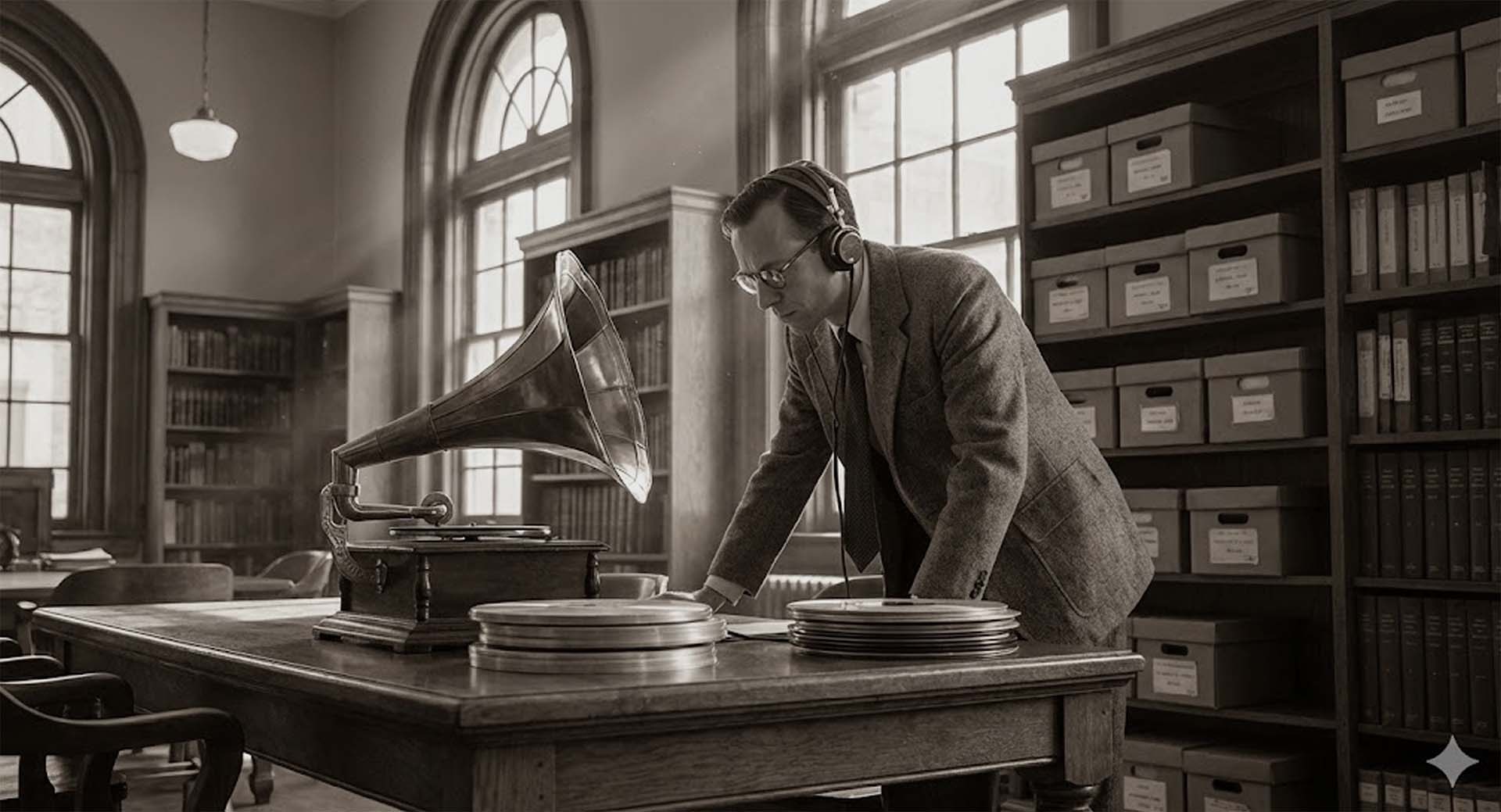
He spent two days a week at the Library, in a small room off the main Archive stacks that Fessler designated as his working space. The room was barely large enough for a table, two chairs, and a listening apparatus—a disc player of older vintage than the FMP’s equipment, with a substantial horn speaker that Fessler regarded with a mixture of affection and apology. “It’s not the most sophisticated,” he had said, when Elias first examined it. “But the signal is honest.”
The signal is honest. Elias wrote that phrase in his notebook, not because he intended to use it professionally but because it seemed to him to contain a useful compression of a complex idea—that what mattered in a listening apparatus was not its elegance but its fidelity, not the quality of its housing but the accuracy with which it transmitted what it had been given.
He thought of this often in the weeks that followed, as he worked through the Archive’s holdings.
III.
The cylinders came first, because that was what the cross-reference project required: the oldest materials, the ones whose relationships to the more recent FMP collections were most likely to reveal patterns of regional tradition, melodic ancestry, community continuity.
The wax cylinders—the earliest ones, dating from the 1890s—were stored in a section of the Archive’s holdings that Fessler approached with a particular quality of physical care, the way certain people approach sleeping animals: not urgently, not timidly, but with a specific consciousness of the fragility of the state they were trying not to disturb. The cylinders were kept in padded cases of their own, the wax surfaces protected from contact by tissue linings, the cases themselves stored horizontally to prevent the wax from developing stress fractures along its vertical axis.
“The challenge,” Fessler explained, during the first afternoon in which they removed cylinders for examination, “is that playing them hastens their deterioration. Every time the stylus runs the groove, it removes a small amount of wax. The voice is preserved in the wax, but the act of listening to it destroys a fraction of what you are listening to.”
Elias held a cylinder in both hands, tilting it slightly under the room’s light, examining the groove with the focused attention of someone looking at fine print. The groove was very fine—finer than the shellac discs he’d been handling at the FMP, finer even than he’d expected. Under magnification, which Fessler kept available for exactly this purpose, it revealed itself as a continuous spiral of extraordinary delicacy, the physical record of a voice that had pressed against a diaphragm decades ago and been translated, through mechanical means, into this tiny valley in wax.
“How many times can they be played before the recording is irreparably damaged?” Elias asked.
Fessler made a considered gesture—not a shrug, which would have implied indifference, but the specific movement of a man acknowledging uncertainty in an area where certainty mattered. “It depends on the quality of the original wax, the condition of the stylus, the ambient humidity, the temperature of the room. The honest answer is: we don’t know with precision. We know that repeated playback degrades the surface. So we play them as seldom as we can while still being able to do the work the archive requires.”
He paused. “Every listening is a small act of destruction.”
Elias set the cylinder down with more care than he had been using.
The cylinders in the Archive’s collection represented recordings from the earliest sustained effort to document American communities’ music—beginning with Jesse Walter Fewkes’s 1890 recordings of Passamaquoddy singers in Maine, the first known American field recordings, made with a machine that had been available for barely more than a decade, by a man who had understood, perhaps more clearly than most of his contemporaries, that what was in front of him would not wait. Those voices, sung into a horn and translated into a spiral of compressed wax, had survived fifty years because someone had made a decision to capture them and because the cylinders had, through a combination of care and luck, not been broken or melted or lost.
He played several during those first weeks, with Fessler’s guidance, using the Archive’s playback apparatus with the careful protocols Fessler had established: proper stylus weight, proper speed, proper approach to the groove. He heard voices from communities that, in some cases, had been substantially dispersed or transformed in the intervening decades—communities whose languages, practices, and ways of organizing meaning had shifted under the pressures of the twentieth century’s first five decades. The voices in the cylinders were, in certain cases, the only evidence that certain songs had existed, the only proof that a particular way of organizing melody and language and rhythm had once been part of a living community’s shared life.
He documented them with his characteristic precision, writing his entries in the small room off the stacks while Fessler worked at the larger table in the adjacent space. He documented them correctly. He documented them with what he could only call, in the private ledger, a growing tenderness—a quality of care in handling that went beyond the professional requirements, that had something of the personal in it, that he acknowledged and could not fully explain.
He was, he understood, becoming attached to the work in a way that exceeded its function. This was not entirely comfortable. He had spent thirty-two years organizing his attachments along functional lines, keeping them at the distance that professional or familial duty prescribed. The cylinders did not fit those lines. They were objects in a collection, which he was being paid—modestly—to help organize. But they were also, impossibly, the voices of people who had died before he was born, pressed into wax by a needle and released by another needle into a room where he sat alone on a Tuesday afternoon in 1942, and the gap between those two facts—the objecthood and the presence—was a gap he found he could not simply cross-reference and file.
IV.
The Texas materials came to him sideways.
He had been working, in the third month of the Library visits, through the FMP’s Texas and Gulf States holdings—the recordings made primarily between 1933 and 1940 by various fieldworkers operating under the WPA’s several music-related initiatives, now held partly at the Archive and partly in the FMP’s own files, their cross-referencing incomplete in the ways that the cross-referencing of materials gathered by multiple collectors with varying organizational philosophies always was.
Texas had been, by the accounting of the collection, one of the more actively documented states. The variety of communities present—Anglo-American settlers, African American communities whose musical traditions carried both the weight of the slave era and the particular resilience of folk forms that had survived through exactly the kind of oral transmission Elias had been reading and hearing about for months, Hispanic communities along the southern border whose music crossed cultural and linguistic lines with the easy authority of things that have never been told they cannot go where they are going—this variety had attracted multiple fieldworkers over multiple years, producing a substantial body of recordings that had arrived at the Archive in batches, each batch the product of a different collector with different emphases and different filing instincts.
The result was a Texas collection that was rich and substantive and, in its current state, only partially accessible. You could find what you knew to look for. You could not find what you did not know existed.
This was, in Elias’s private taxonomy, the worst kind of organizational failure: not the obvious failure of misfiling, which created a defined problem with a defined solution, but the invisible failure of incomplete integration, which created a territory of unknown contents—things present but unfindable, preserved but effectively lost.
He had told Fessler this, in the careful language of a professional making an observation rather than a criticism. Fessler had agreed, with the weary agreement of a man who has understood a problem for years and has not had the resources to solve it.
“How long would it take to do a proper integration?” Fessler had asked.
“For the Texas materials specifically?” Elias calculated quickly, with the automatic accuracy of a man for whom estimation was a professional discipline. “Three to four weeks of sustained work. Assuming the field notes from the various collections are as detailed as the better examples I’ve seen.”
Fessler had been quiet for a moment. Then: “The WPA may not continue into the next fiscal year.”
“I know,” Elias said.
“If it ends, the FMP ends with it,” Fessler said. “These materials would be absorbed into the Archive’s general holdings, and the cross-referencing work you’re describing would fall to whatever staff we have available, which is currently insufficient for what we already have.”
“Then we should do it now,” Elias said.
“Yes,” Fessler said. “We should.”
He had begun the Texas integration work on a Monday in late June, when the Washington summer had settled its full, humid weight over the city and the Library’s interior temperature, which was regulated by the building’s stone mass rather than any mechanical system, became one of the primary reasons to spend as many hours as possible inside it. He carried his forms and his pencils and his notebook and installed himself at the small table in the listening room, where Fessler had arranged for the relevant boxes to be brought from the stacks.
There were eleven boxes, each labeled with a collector’s name or initials and a date range and a broad geographic designation. Some were tidy—Ruth Canfield’s neat, systematic labeling was immediately recognizable even in materials she had submitted to the Library rather than to the FMP office. Others were the work of collectors whose organizational priorities had been elsewhere: materials grouped by vague type rather than specific content, labels that were evocative rather than informative.
He opened the first box and began.
V.
By the third week, he knew the Texas collection as well as any person who had not been to Texas.
He knew its range: from the border communities of the south, where corridos moved between English and Spanish with the fluid confidence of a living language, to the northern plains communities where Anglo-American folk traditions had settled into the landscape with the slow tenacity of imported plants that had found, against expectation, that the soil suited them. He knew its principal personalities—the performers who appeared in multiple collections, whose voices he’d now heard from several angles, through the recordings of several different fieldworkers, acquiring through that multiplicity a kind of three-dimensionality that single recordings could not produce.
He knew its gaps, which were considerable. Certain counties were heavily documented, others barely touched. Certain communities had welcomed the FMP workers with openness; others had been reluctant or unavailable or simply missed, the fieldworkers having moved through on schedules that could not always accommodate the patience that real documentation required.
And he knew, with the particular precision that comes from handling something daily, the condition of each disc in each box: which were pristine, which were cracked or chipped, which showed signs of the humidity damage that the Texas climate had visited on materials stored without adequate protection, which had labels that had survived intact and which had labels that had been damaged, worn, or—in a few cases—entirely absent, the disc’s identity determinable only through the contents of the accompanying field notes, if such notes existed.
It was in the ninth box, on a Wednesday afternoon in late July, that he found it.
The ninth box was from a collector identified in the FMP’s records as “H.B.”—a set of initials that corresponded to no fieldworker he recognized from the office roster, suggesting someone working either under contract or as a volunteer during the earlier years of the program. H.B.’s materials were, in terms of organizational quality, mid-range: not Ruth’s meticulous system, but not the cheerful disorder of some others. The discs were in sleeves, the sleeves labeled, though the labeling was sometimes more summary than specific.
The box contained sixteen discs. He worked through them in order, as was his habit, beginning his entry for each before moving to the next. Numbers one through eleven were what he had come to think of as the essential Texas: fiddle tunes, church music, a few pieces that straddled the line between call-and-response work song and spiritual, a corrido from near Laredo that the collector had noted, in brief field notes clipped to the sleeve, was “sung by a man of about sixty who said his father had made it up.”
The twelfth disc’s sleeve was slightly apart from the others, as if it had been placed in the box last or had shifted during transit. The sleeve bore a label in H.B.’s hand, which Elias had come to recognize over the eleven preceding entries: a specific capital T, a specific way of forming the letter G, a consistent preference for abbreviation.
But the label on this sleeve was different from the others. H.B.’s entries for the other discs had been complete, if brief: performer name or designation, location, song type, date. This label had been started and then, apparently, left incomplete—or had been complete and then damaged, the ink faded and smeared by moisture until only a portion remained legible.
He tilted the sleeve toward the window’s light.
He could make out: “TX – Misc. Vocals, 1936–37.”
Below that: a partial word that might have been a name, or a place, or a title: “Dallas—” and then a smear where the rest had been, followed, after the smear, by two letters that might have been “L” and “e,” though the confidence with which he could assert this was qualified by the ambiguity that age and moisture created in old ink.
And then below that, a partial notation: “—remarkable—” which was the only word on any of the eleven preceding disc labels that had expressed anything approaching an evaluative judgment. H.B.’s other entries were purely descriptive. Whatever this disc contained had produced, in a fieldworker accustomed to remarkable things, a remark.
He set the sleeve on the table.
He looked at it for a moment.
Then he reached for the disc.
VI.
The first thing the disc contained was silence.
Not the silence of an empty groove—he had heard enough discs by now to know the difference between a disc that had nothing on it and a disc that had something on it preceded by a few seconds of room tone, the captured ambient noise of a space before the performer began. This was the second kind: a silence that was full rather than empty, the silence of a room that held a presence not yet performing.
Through the horn speaker of the Archive’s player—the one Fessler had called honest—that room tone reached him as a warm, almost tangible atmospheric effect: the dust of a Texas summer afternoon caught in a moment just before something happened.
Then a voice spoke.
Not the voice he would come to know. A different voice, businesslike, male, the voice of the fieldworker, whose words he could make out only partially through the surface noise of the shellac: “…take as long as you need… just go ahead when you’re ready…”
A pause. Longer than was necessary for the singer to orient himself. Long enough, Elias thought, for a man to decide something—or to accept something he had already decided and had been briefly reconsidering.
Then the voice began.
He had been listening to voices from discs and cylinders for nearly a year. He had developed, through that listening, an ear for what was good in a recording and what was extraordinary. He knew the difference between competence and artistry. He knew what it felt like when a voice was operating at its capacity, when the singer was fully present rather than partly present, when the song was being inhabited rather than performed.
He knew all of this, and none of it prepared him.
The voice was a baritone at its most natural register, but the word baritone—which he had applied to many of the recordings he had cataloged—felt insufficient for what he was hearing. A baritone was a range, a position on a scale. This voice had range but was not reducible to it. It had, below and inside the baritone register, a quality that was less like pitch and more like material—as if the voice were not made of air vibrated by tissue but of something denser, something that had been in contact with the ground for a long time and had taken on its properties: solidity, persistence, the specific weight of things that do not move easily but, when they move, move with authority.
The song was a work song—or had the structure of a work song, the rhythmic pattern of something meant to accompany labor, the call and its own partial response folded into a single voice because no group was present to provide the answer. He sang it alone, and the absence of a group to respond gave the call a quality of echo-without-echo, a phrase sent out into a room and returning, in the next beat, as its own reply, slightly changed by the distance it had traveled even if that distance was only the room’s width.
The lyrics described physical work: lifting, cutting, the movement of material from one place to another. But the language was not literal in the way of a directions manual. It was figurative in the specific way of folk music that had been shaped by communities for whom the difference between a work song and a spiritual was not a categorical boundary but a matter of emphasis—the same reality described from slightly different angles. He sang about the weight of what he carried, and the weight was both the material weight of the thing in his hands and the other weight, the one that every man who has ever labored for reasons beyond his own choosing has carried alongside the physical one.
Elias sat perfectly still.
He was aware of himself sitting. He was aware of the room around him, the shelves, the window, the low afternoon light. He was aware that he had entered a professional engagement with a disc in a collection he was being paid to organize, and that the appropriate response to this engagement was the notepad and the pencil and the systematic entry that he had produced for the eleven discs preceding this one.
He did not reach for the notepad.
The voice moved into a second verse. The pattern was the same—the single-voice call-and-response, the work-song rhythm—but the melody shifted slightly, not resolving in the direction the first verse had suggested but moving sideways, toward an interval that he had not heard in the previous Texas materials, an interval that felt, to his now-experienced ear, like the place where the Anglo-American folk tradition and something older met and decided to travel together for a while.
He thought, involuntarily: who taught you that?
It was not a cataloger’s question. It was a listener’s question—the question of someone who had heard something and wanted to know its full genealogy, not for professional purposes but from the specific hunger of being moved by something and wanting to understand the source of what moved you.
The third verse dropped lower. The voice descended to a register that should, by the ordinary physics of vocal production, have lost definition, should have become merely dark rather than specific. Instead, it became more specific—as if the lower register were the voice’s natural habitat, the depth at which it moved without effort, and the preceding verses had been a kind of ascent into the light that was interesting and beautiful but not home.
In the lower register, the lyrics changed character. They stopped describing work and began, in the compressed, elliptical way of folk verse that trusts its listener to complete what is left incomplete, to describe something else: a road, a direction, the particular quality of being in motion without certainty of destination. “Lord, I been a long time,” the voice said, and the phrase was both line and breath, both lyric and aside, delivered to the room at large and also, somehow, to no one in particular, which made it—paradoxically—feel addressed to every particular person within its range.
The disc ended.
The stylus rode the inner groove, and the room tone returned for three seconds, and then the disc ended and the player’s motor continued its rotation in silence.
Elias sat with the silence.
He could not have said how long. The quality of the room’s light had changed slightly when he finally reached for the disc and lifted it from the platter with both hands—the care of a man handling something he now understood was not simply an archival object, or not only that.
He looked at the label again.
“Dallas—” and then the smear. “—L—e—” or possibly “—Lee.” And then “—remarkable—” in H.B.’s hand, which he now understood with a precision that H.B. had perhaps not even intended to convey—the word simply put there because it was the word that fit, the word that the fieldworker had apparently felt obligated to place in the record before moving on to the next entry.
Remarkable.
Yes.
He returned the disc to its sleeve. He placed the sleeve on the table in front of him. He looked at the remaining four discs in the box and then, with a deliberateness that was slightly out of character, he set them aside.
He opened his notepad. He wrote, in the upper right corner: “TX – Misc. Vocals, 1936–37 – ‘Dallas—’ (partial) – Disc no. 12 of 16, Box 9, Collection H.B.”
Then he looked at what he had written for a moment.
Then he wrote, below the catalogue entry, in smaller letters, separated from the formal notation by a line: “Single male vocal, unaccompanied. Work song/spiritual hybrid. Three verses. Performer identification incomplete – label damaged. Voice: extraordinary.”
He looked at the word extraordinary for a moment, then drew a single line through it.
He replaced it with “remarkable,” using H.B.’s word, which he had earned.
Then he put the notepad down and sat in the late afternoon light of the Archive’s listening room, in the Library of Congress, in Washington, D.C., in the summer of 1942, and tried to understand what had just happened to him.
VII.
He came back the next day, which was not one of his designated Library days.
He had not planned to. He had left the Library the previous evening and walked home and eaten his dinner and read and gone to bed at the usual hour, and at some point in the night—he could not identify when, only that it was before dawn and after the deeper part of sleep had passed—he had been aware that he was going to return to the Archive the next morning, and that this decision had been made without his full conscious participation, the way certain decisions are made by the part of a person that operates below deliberation.
He told himself, on the walk to the Library, that there were professional reasons. The cross-reference work was at a critical point in the Texas materials; there were several items in Box 9 that required consultation with Fessler before they could be properly entered. These were true things, and they provided the professional framing within which he was willing to conduct himself.
He found Fessler at his desk and mentioned, in passing, that he’d like to continue with the Texas work. Fessler, who appeared unsurprised—because Fessler was rarely surprised by anything, having developed over decades in the Archive a deep equanimity about the variety of reasons that brought people to its holdings—indicated the small listening room and said the materials from the previous day were still on the table, undisturbed.
He closed the listening room door behind him.
The box was there. The disc in its sleeve. He picked up the sleeve, turned it in his hands, looked again at the partial label.
“Dallas—” and the smear and the partial letters.
He tilted the sleeve in the light, as he had done the previous day and in his memory several times since. He had been running the partial letters through his mental catalogue: what names began with Dallas and continued in a way consistent with those partial strokes? It might be a surname—he had encountered Dallas as both first name and family name in the Texas materials, the city’s name having percolated into the naming practices of the surrounding region. It might be a place designation—a song associated with the Dallas area, the city or the county or a smaller settlement sharing the name.
The “L” and the possible “e” at the end were too partial to be decisive. They might be “Lee.” They might be “Long.” They might be something else entirely, the letters’ resemblance to those forms a function of his desire to see a name rather than evidence that a name was there.
He placed the disc on the platter.
The second listening was different from the first in the way that second listenings always differ: stripped of the shock of encounter, exposed to the attention that shock had briefly occupied. He heard, this time, what the first listening had given him no room to notice—the slight imperfections in the shellac’s surface that added a faint, rhythmic crackle to the voice, the way the microphone distance had been set so that the voice occupied a middle space, not too close and not too far, the decision of a fieldworker who had listened to what was in front of him and made a sensible judgment.
He heard the room. He had not consciously heard the room before—had registered it, peripherally, as the background condition of the recording, but had not attended to it. Now he attended. The room was not acoustically neutral: it had a slight reverb, the kind that a medium-sized space with hard walls produces, giving the voice a small, inhabited echo. It was not a church—the reverb was too short for the stone and plaster of sanctuaries he’d heard in other recordings. It was perhaps a community hall, perhaps a house with several people absent and their absence registered in the space’s acoustic openness.
He heard, at the end of the second verse, what he had not heard the first time: a faint sound in the background, barely above the surface noise. Not music. Not language. A breath—someone else in the room, the fieldworker or an observer, drawing air in the brief silence between the verse and its continuation. Someone else, present in the room with this voice, also listening.
He found this detail—one breath, barely audible, from an unknown person in a Texas room in 1936—more affecting than he could account for professionally.
He played the disc a third time.
VIII.
The after-hours visits began in August.
The Library, like most federal buildings, maintained evening hours on certain days—a policy that had been established for the benefit of working people who could not access its resources during the standard business day. On those evenings, which ran until nine o’clock, a reduced staff managed the building while scholars and researchers continued their work at the reading room tables and, in some cases, in the specialized rooms that had been made available for their use.
Fessler had arranged for Elias to have a key to the listening room. This was a practical accommodation—there were times when Elias needed to work past the regular hours that Fessler kept, and it was more efficient for him to be able to let himself in and out than to interrupt Fessler or wait for a staff escort. The arrangement had been established in the spirit of practical usefulness and Elias had used it, in its first weeks, strictly in that spirit.
The first time he stayed late with the Texas discs, he told himself he was still working. He had, by that point, completed the formal cross-reference entries for all sixteen discs in Box 9 and had moved on to Box 10. He had no professional reason to return to the twelfth disc of Box 9. The entry was written and correct. The disc was properly housed and documented. It had been integrated into the cross-reference system with the precision that he applied to everything.
He took it out anyway.
He carried it from the shelf where it had been temporarily placed during the integration work and set it on the player’s platter and closed the listening room door and sat in the chair in the evening’s quiet, with the building’s nighttime sounds reduced to the distant suggestion of footsteps and the occasional creak of the Library’s stone frame responding to the day’s accumulated heat.
He played it once.
He sat for a moment in the silence after.
He played it again.
He was aware, during the second listening, that he was doing something he had not done before with any recording: not listening for content, not attending professionally, not building the mental catalogue entry that accompanied his usual engagements with the collection. He was simply listening. Openly. Without the scaffolding of purpose.
He was also aware—because self-awareness was one of his more reliable qualities, however inconvenient—that this particular voice had produced in him something he did not have a professional or personal category for. Not the tenderness he’d felt for the cylinder recordings, which was the tenderness of great age and great fragility. Something more active than that. Something that sat in the space between being moved and being addressed.
He had been reading, over the preceding months, the academic literature on folk music and its functions—the theoretical writing that Thomas had recommended and that Fessler had supplemented with materials from the Archive’s own library of ethnomusicological scholarship. He had read about the communal function of folk song, about the way certain songs carried the weight of communal experience in a form that any individual member of the community could access without mediation—that the song was, in this sense, both personal and public simultaneously, the individual voice and the collective history occupying the same breath.
He had read this with professional interest, as useful context for the cataloging work. He had not expected to feel it.
But the voice on Disc 12 of Box 9 did something to him that the theoretical writing had described but not prepared him for: it made him feel, for the duration of the recording’s three verses, that the distance between himself and the experience being described had temporarily closed. That whatever the singer was carrying—the work, the weight, the long time on the road—was, in the frame of the recording and the room and the particular quality of his listening, also something he was carrying.
He was a thirty-two-year-old accounting clerk with a 4-F classification and a harmonica he had never learned to play, sitting alone in the Library of Congress at eight in the evening in the summer of 1942, in a room full of voices from places he had never been, listening to a man whose name he could not fully read sing about a weight he could not precisely identify, and the impossibility of the connection—across time, across geography, across every category of human experience that should have made this encounter a purely professional transaction—was not, in the event, an obstacle.
It was, he thought, the whole point.
He played the disc a third time.
And then, carefully, after the final groove had run its course and the room tone had faded and the player’s arm had lifted and rested, he removed the disc from the platter and returned it to its sleeve and placed the sleeve in its designated location in the temporary integration files.
He wrote in his notebook, sitting at the table in the listening room with the evening stretching quietly around him: “Third listening. Voice: consistent across repetition. Does not lose quality with familiarity. Most recordings reveal themselves gradually, exhausting their initial effect through repetition. This one does the opposite.”
He paused. He looked at what he’d written.
Then he added, below it: “Cannot determine whether this is a quality of the recording or a quality of the listener. Possibly both. Possibly indistinguishable.”
He closed the notebook. He gathered his things. He turned off the player and straightened the chair and checked that the room was in the condition he’d found it, which was his habit everywhere he went.
At the door, he paused.
He had not planned to look back at the shelf where the disc was housed. He looked back anyway. It was the same shelf, the same row of sleeves, the same strip of brown cardboard with the temporary integration number marked in pencil.
There was nothing to see that he had not already seen.
He understood this. He looked anyway.
He was beginning to understand, in the specific way that realizations come to careful people—not as a flash but as the slow development of something true for longer than it has been visible—that this disc and its partial label and the voice inside it were going to require more of him than a cross-reference entry.
He did not know yet what more it would require.
He turned off the light. He locked the door. He walked home through the August evening while the city transitioned from its daytime self to its nighttime one, the streets shifting their quality without announcement, the way cities did—the same geography, the same buildings, the same distances, but the light changed and the sound changed. Something in the purpose of movement changed with them.
He walked, thinking of nothing in particular.
Which was, for Elias Thorne, who thought of something particular in almost every waking moment, its own kind of sign.
Behind him, in a locked room in the Library of Congress, in a sleeve in a box in an integration file, a voice waited in shellac, patient as wax could be patient, which was, if no stylus touched it and no moisture reached it and no careless hand dropped it, a very long time indeed.
The voice did not know it was waiting.
Elias, walking home in the August dark, barely knew he was listening.
But the listening had begun, and it would not stop, and that was the fact of the matter—the entry in the permanent ledger, the number that would not be reconciled away: a voice, a man, a partial name, and a listening that would constitute, in the quietly catastrophic accounting of a single life, the most significant transaction of his long, careful, ordinary years.
