
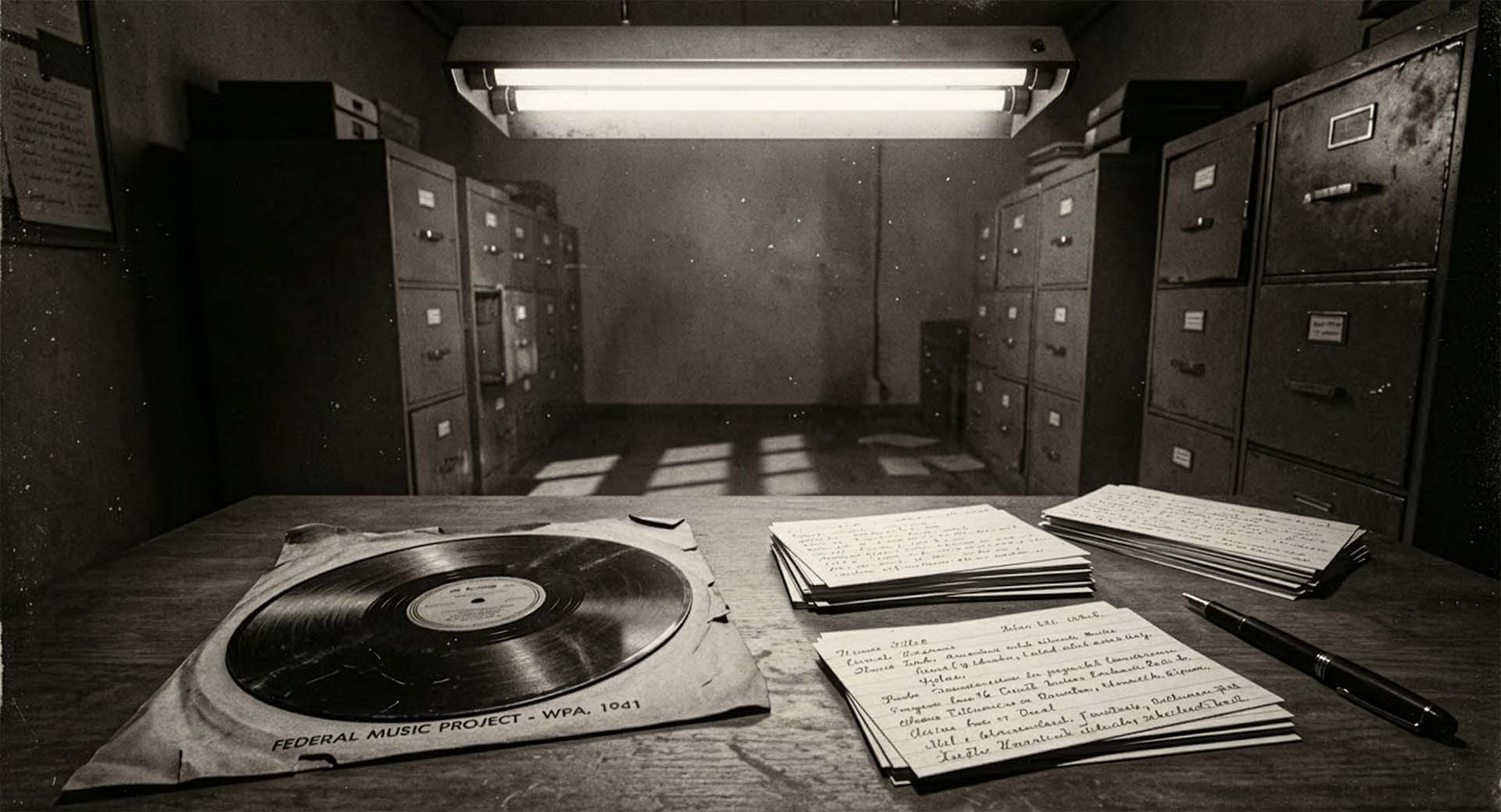
The first thing you noticed about Elias Thorne, if you noticed him at all, was the pencil.
He kept it behind his right ear with the practiced unconsciousness of a man who has worn something so long that his body has incorporated it, as naturally as a callus or a scar. It was always sharp. He sharpened it each morning before he did anything else, turning the small brass-handled sharpener in tight, deliberate circles, collecting the curled shavings in the waste bin by his left knee with the care of a man who did not want to leave evidence of his own processes. When he finished, he tested the point against the ball of his thumb—not hard enough to mark the skin, just enough to confirm resistance—and then he placed it behind his ear and did not touch it again until the numbers required it.
Nobody at Barfield & Associates Municipal Accounting had ever commented on the pencil. In three years of employment, in an office of eleven people who sat close enough to hear each other’s lunches being unwrapped, nobody had said a word about it. This was, Elias had come to understand, because nobody particularly noticed Elias Thorne, and nothing that attached itself to Elias Thorne—not a pencil, not an opinion, not an absence—was therefore going to attract comment.
He had thought, initially, that this was a problem he could solve. When he’d first taken the position at Barfield in the spring of 1939, fresh from two years of bookkeeping night courses and the hard, specific humiliation of the previous four years—the Depression years, the lean years, the years in which every person he knew had developed the sunken-eyed wariness of someone who sleeps lightly—he had told himself that the invisibility was temporary. A function of newness. He would settle in, demonstrate his competence, find the rhythm of the place, and then, gradually, he would become present to these people in the way that people in offices became present to each other: through shared complaints about the coffee, through the slow accrual of small opinions about each other’s habits, through the gradual, ordinary commerce of proximity.
Three years had passed, and none of this had happened in the direction he’d intended.
He was competent. This much was inarguable and in fact constituted the only form of recognition he reliably received: difficult reconciliations were placed on his desk with the wordless confidence of people who understood that he would complete them correctly. Ledgers that other clerks had muddled—transposed figures, misapplied credits, columns that refused to balance because someone had added where they should have subtracted—arrived in his inbox and left it corrected, without drama. Mr. Barfield himself had said, once, in the hallway, with the brisk satisfaction of a man delivering a verdict rather than a compliment, “Good work, Thorne,” and kept walking.
That was the extent of it.
The office had its own social architecture, as all offices do, and he had studied it with the thoroughness he applied to everything, which was considerable. At the center of the architecture was a man named Carroll Prentiss.
Carroll Prentiss was thirty-one years old, which was exactly Elias’s age, a coincidence that Elias found quietly maddening. Carroll had the kind of face that people described as “open”—broad forehead, easy eyes, a mouth that seemed always on the verge of a remark rather than in the aftermath of one. He wore his suits with a slight looseness that was not sloppiness but ease, as if the clothes understood that they were in the service of the man rather than the reverse. He kept his hair combed back from his forehead with a confidence that Elias’s own hair—thinner, more equivocal in its direction—had never managed. He told jokes that landed. He remembered the names of people’s children. He asked questions that people actually wanted to answer.
Carroll Prentiss was, in the vocabulary that Elias had never found adequate to the concept but could not improve upon, cool.
Not cool in the temperature sense, not cool in the indifferent sense. Cool in the sense of a man who occupied his own skin with a comfort that suggested he had never seriously doubted his right to be in it. Cool in the sense of a man whom other men wished, without full awareness of the wish, to be near. Cool in the way that the musicians Elias watched through club windows on Friday nights were cool, the way the horn players stood at the edge of the stage with a casualness that was not laziness but mastery—as if the instrument in their hands were simply an extension of their existing authority, rather than a skill they had labored over, a thing they had sweated to earn.
Elias had labored over a great many things. He had the bookkeeping certificates to prove it. He could balance a municipal water authority’s operating accounts in his sleep, and in fact occasionally did something resembling this, surfacing from half-dreams to find himself mentally correcting a ledger entry from the previous afternoon. He was reliable, precise, and thorough.
None of these qualities had ever made anyone want to stand near him.
The office at Barfield occupied the second floor of a building on F Street in Washington, D.C., eleven blocks from the mall and the government apparatus that had, since Roosevelt’s first term, expanded with the urgent, ungainly growth of an organism that had found its food supply. The New Deal had meant new agencies, new programs, new offices requiring new record-keepers, and while Barfield & Associates was a private firm working on municipal contracts rather than a federal operation, it existed in the atmosphere of that expansion—benefiting from it, aware of it, occasionally bumping against it at the margins of jurisdiction.
The city itself was in transition. The Depression’s worst years had passed, but they had not passed cleanly; they had left behind a residue of caution, a tendency in people who had experienced real scarcity to treat the present’s relative stability as provisional. The streets felt like a held breath. Men wore their hats pulled lower than fashion strictly required. Women bought fabric rather than dresses and made do with the sewing their mothers had taught them. Money, when it moved, moved carefully.
And yet, under the caution, something else had been gathering. The city hummed with the low-frequency buzz of preparation. Europe’s war, officially distant, was practically not distant at all: the newspapers spoke of it with increasing proximity, and the men who worked in the government buildings along Pennsylvania Avenue and Constitution Avenue spoke of it in terms that made clear they were not reporting on a foreign event but managing an approaching one.
Elias read the newspapers with the thoroughness he brought to ledgers. He knew the map of Europe better than most of his colleagues. He was, in this as in most things, well-informed and well-organized and comprehensively invisible in his knowledge.
He was also, he had recently received confirmation, 4-F.
The draft classification—”not acceptable for military service”—had come through in the winter, following an examination that had identified in his right eye a deficiency of the kind that the Army’s medical officers found disqualifying. The irony was not lost on him: he had spent his professional life seeing things clearly, catching errors that others missed, reading numbers with a precision that his employers valued above almost anything else, and the government had looked at his right eye and decided he was not useful.
He had folded the classification notice and placed it in the bottom drawer of his desk at home, under a copy of Cost Accounting Principles and a spare pencil case. He had told no one about it. There was nothing to tell. It was a piece of paper confirming what he had already, in the larger sense, been told by the architecture of his existence: that he did not fit neatly into the available shapes.
He was not bitter about this, or not exactly. He had a precise enough relationship with his own feelings to know the difference between bitterness, which was hot and consuming, and the quieter thing he actually felt, which was more like the permanent awareness of a gap—a space between what he was and what he would have chosen to be, a space through which a certain amount of cold air moved, constantly, without ever quite chilling him enough to force action.
He wanted to be different. He had always wanted to be different.
This was the secret that his ledgers and his sharpened pencils and his correct answers kept tucked away, as neat and invisible as the 4-F notice in the bottom drawer. He did not want to be reckless or dangerous or disreputable. He wanted something subtler and, in its subtlety, harder to achieve: he wanted to be the kind of person who moved through rooms as if rooms were glad to have him. He wanted to be the kind of person who said things that other people remembered. He wanted to be, in the specific way that certain people were, present—not as an accounting clerk with a perfect error rate but as a human being with some quality that made other human beings feel the difference between a room with him in it and a room without.
He did not have this quality.
He was reasonably certain he never had.
The walk from Elias’s rented room to the offices of Barfield & Associates took twenty-two minutes at his natural pace, twenty-six if he allowed himself to look at things along the way. He usually allowed himself to look. The extra four minutes were a small price for the content they delivered, and Elias, who had learned to be economical about pleasures, got considerable return from his morning inventory of the city.
He lived in a rooming house on the edge of a neighborhood that had once been aspirational and was now simply adequate—a distinction the Depression had made across large sections of Washington, converting ambition into maintenance, dream into function. His room was on the third floor, facing the street, with a window that admitted the morning light at an angle he’d come to find companionable. The room contained a bed, a desk, a chair, a small bookcase, and a washstand. He had arranged these items with a care that, to the occasional visitor, suggested either a very organized man or a very lonely one. Both interpretations were partially accurate.
He kept three things on the bookcase that were not reference materials or professional texts. The first was a small photograph of his mother, taken in the early twenties, in which she wore an expression of effortful pleasantness that he recognized as the expression of someone who had not been asked what they actually felt before the shutter opened. She had died when he was seventeen, and he thought of her with the specific, contained grief of someone who has had many years to organize the feeling into something that could be stored without consuming much space.
The second was a carved wooden box, about the size of a hardcover book, that had belonged to his father and contained nothing of significance—a few old coins, a cuff link missing its pair, a folded piece of paper with a name on it that he had never recognized and his father had never explained. He kept the box not for its contents but for its weight. It was solid and specific. It had existed before him and would likely exist after him. He found this comforting.
The third was a harmonica.
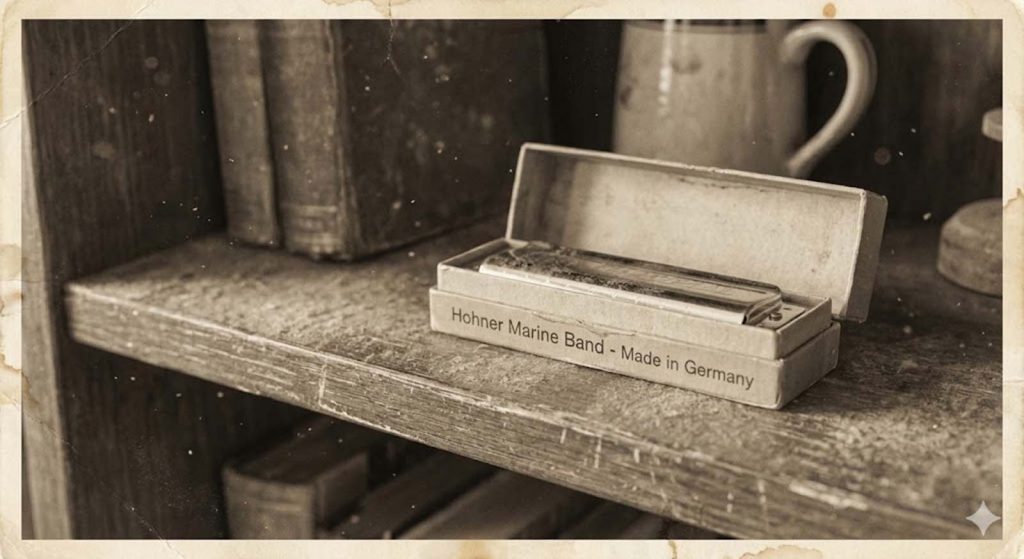
He did not play it. He had never played it, not with any skill. He had bought it six years ago, in the worst year of the Depression, when the accumulated smallness of his circumstances had compressed to a point where he’d needed to assert some small claim to a different life. He had paid thirty-five cents for it from a street vendor in Baltimore, before he’d come to Washington, before the bookkeeping courses and the Barfield position, during the period he thought of as “the shapeless time.” He had held it and drawn a single experimental breath through it and produced a wheeze that made the vendor glance over without interest.
He had not tried again. But he had not sold it either. It sat on the bookcase in the same relationship to his daily life that most of his desires maintained: present, identifiable, and entirely unactualized.
On the mornings of his walk to the office, he passed a barbershop whose owner, a man named Delroy, arrived early to open and always had a radio going in the back. The radio played whatever the station felt like at seven in the morning, which was usually news, occasionally classical, and sometimes, if the dial had drifted or been deliberately moved, something else: a jazz piece, a blues phrase, a stretch of swing music that reached the sidewalk with a warmth that the morning air did not yet have. On those mornings, Elias slowed his pace without fully stopping, catching what he could of the sound through the glass.
He knew enough to recognize what he was hearing. He was a careful reader, and his reading had covered, over the years, a reasonably wide territory—including the music that had been moving through American culture for the preceding two decades with the force of something that had been suppressed for a long time and was no longer willing to stay quiet. He knew the names: Armstrong, Ellington, Holiday, Smith. He had read about the Great Migration and what it had carried northward, about the cross-pollination of field hollers and church music and the blues into something that the music critics could barely classify fast enough to keep up with. He had read about it the way he read about most things: thoroughly, from the outside, without personal access to what he was reading about.
This was the essential structure of his relationship to most of what he found interesting. He understood things correctly and enjoyed them at a remove.
He understood, for instance, the mathematics of jazz improvisation—the way a soloist moved within and against the established chord structure, creating tension and resolution through controlled deviation from the expected. He could describe this. He could not do it, and he had never been able to imagine himself doing it, because doing it required not just knowledge of the structure but an entirely different relationship to error than the one he’d spent his life cultivating. In jazz, a wrong note was only wrong if you left it wrong. You could take any note and, by the authority of your next choice, make it not wrong—make it the right note that everything else needed to adjust to. This required a confidence in the rightness of your own improvised judgment that Elias found both thrilling to observe and personally unimaginable.
He brought to his mornings, as he brought to his ledgers, the disposition of a witness.
On a Tuesday in late October of 1941—a Tuesday that felt, when Elias looked back on it, like the last ordinary day of a particular phase of his life, though he could not have known this while he was in it—he ate his lunch at his desk.
He did this every day. The office had a habit of lunching in groups at the diner on the corner, a habit consolidated by Carroll Prentiss, who was the kind of person around whom habits naturally consolidated. Most of the clerks went. Elias had been invited, in the early months, with the routine hospitality that offices extend before they have fully determined where someone belongs in the social map. He had gone twice, ordered a sandwich, answered questions that were asked of him, and said nothing spontaneous or memorable. After the second time, the invitations had simply ceased—not coldly, not with any deliberate exclusion, but with the natural contraction that happens when an organism finds its shape and sheds what doesn’t fit.
He did not take offense. It would have been inaccurate to claim he didn’t notice, but he had enough self-awareness to understand that what had happened was not cruelty but simple fit. He was not made for group lunches. He ate efficiently and alone and used the remaining time to read, which was what he would have preferred anyway.
Today he was reading about the Resettlement Administration.
The article—from a trade journal he picked up irregularly, focused on government programs and their administrative structures—described the RA’s activities in the mid-thirties, including its music units, which had sent fieldworkers into government-built communities to document the musical traditions of migrant and rural residents. The author wrote with academic precision about “ethnomusicology” and “oral tradition” and the challenge of preserving music that existed primarily in performance rather than in notation.
Elias read this paragraph twice.
He was not sure why it arrested him so completely. He had read about the New Deal programs before—their scope, their politics, their administrative variations. He knew about the WPA in the general sense that any literate person living in Washington in 1941 knew about it: as the vast, controversial machinery that had put nearly eight million people to work over the preceding years on everything from road construction to art murals. He knew that the Federal Music Project had been part of this machinery, employing musicians and researchers in the task of documenting and performing America’s folk traditions.
But something about the phrase “music that existed primarily in performance rather than in notation” stopped him.
He put the journal down and looked at the far wall of the office—a wall decorated with nothing more interesting than a calendar and a water stain shaped vaguely like the state of Florida—and stayed stopped for a moment.
Music that existed primarily in performance. Music that was, by its nature, disappearing. Music that had to be actively chased, captured, held in some form, or it simply ceased to exist when the people who carried it died or moved on or stopped singing for the government microphone and went back to their lives.
He picked the journal back up. He read the rest of the article with a focus that, had Carroll Prentiss been watching, would have been immediately distinguishable from his usual reading focus—which was itself quite intense—by some quality of leaning, some quality of the forward edge of his attention pressing closer to the page.
The article described the Archive of American Folk Song at the Library of Congress—established in 1928, expanded significantly through the New Deal era—as a repository for recordings collected from communities across the country. It mentioned Alan Lomax and his extensive field work: the trips into rural communities, the portable recording equipment, the thousands of songs captured from ordinary people who had been, in most cases, entirely unaware that what they carried was of historical significance.
He read about the Passamaquoddy recordings from 1890, made by a man named Jesse Walter Fewkes in Maine—the earliest known American field recordings, songs of a community that had assumed their traditions were their own private property and had found them, decades later, held in a federal archive.
He set the journal down again.
He thought about that: a community singing in what they believed was privacy. A man arriving with equipment. The songs leaving the room in a form that could outlast the singers, could outlast the language itself. What did it mean to capture something like that? What did it mean to be the one who did the capturing?
He ate the last of his sandwich without tasting it and returned to his columns.
But the article’s language stayed with him, running in the back of his mind with the persistence of a tune heard once and not fully absorbed—the kind that surfaces later, unexpectedly, while you are doing something else, demanding more attention than you initially gave it.
Music that exists primarily in performance.
He thought of Delroy’s radio. He thought of the club on U Street that he passed occasionally on Friday evenings, close enough to hear the music from the sidewalk if the door opened at the right moment. He had never gone in.
The Friday in question—the Friday that mattered, the one that Elias would later, in the dark quiet of his basement years, sometimes return to as a landmark—was the first Friday in November, 1941.
He had not planned to walk down U Street. His route home did not naturally pass that way. He had made a detour, deliberately, which he acknowledged to himself with the honesty he applied to most things, including his own small willfulness. He had been thinking, all week, about the article. About fieldworkers and recordings and the idea that music could exist in a state of perpetual imminent disappearance, requiring human intervention to persist.
He had thought, with a specific and uncomfortable clarity, that he had never intervened in anything.
The club was called Dillard’s, or had been called Dillard’s since a sign had been nailed up in the previous decade with that name in hand-painted letters that had since faded to a gentle suggestion of themselves. He knew it by reputation, or rather by the reputation of the block, which was the kind of block that certain people avoided and certain other people sought with the focused urgency of pilgrimage. The music that came from it on Friday nights was, by general acknowledgment, the best music available within walking distance of where Elias lived, which meant it was very good indeed.
He stationed himself on the sidewalk across the street, at an angle that gave him a clear view of the entrance without placing him directly in the path of the people coming and going. This was his habitual position at the margins of things: not so far away as to suggest disinterest, not close enough to require participation.
The door opened and closed in irregular intervals, and with each opening, music escaped into the street.
It was a quintet—he could tell from the texture of the sound, even in its fragmented, door-dependent form. Piano, bass, drums behind them. Out front, a trumpet and a voice. The voice was a woman’s, low and specific, applying itself to the melody with a combination of precision and abandon that he associated with very good jazz singing—the singer knew the song so thoroughly that she could afford to approach it indirectly, could afford to arrive at a note from an unexpected angle and make the note seem, retrospectively, to have been waiting for exactly that approach.
He stood on the sidewalk and listened with a focus that he was not directing. It was simply happening to him, the listening, the way that real music happens to people who have been waiting for it without knowing it.
A couple came out the door—a man in a dark suit, a woman in red—and stopped on the sidewalk to finish a conversation they had apparently started inside. They stood in the spillage of warm light from the club, laughing about something, the woman’s hand on the man’s lapel in the particular easy way that suggested long familiarity, the man’s face turned toward her with an attention that required no effort because attention was simply what you gave when the thing in front of you was the most interesting thing available to you.
Elias watched them with the concentrated attention he gave to things he wanted to understand.
They were comfortable. Not comfortable in the economic sense—their clothes were not expensive—but comfortable in the deeper sense: comfortable in the fact of each other, comfortable in the fact of themselves, comfortable in the fact of standing on this sidewalk on this November night with music coming through the door and the city going about its business around them. They occupied their moment without apology and without effort.
He turned back to the sound.
The trumpet had taken the melody by now, and the voice had stepped back, and the interplay between them was the specific conversation of two instruments that understood each other’s grammar—finishing each other’s phrases, leaving spaces that the other filled, creating between them a single continuous musical thought that neither could have produced alone. The drummer, behind both, kept time with the casual authority of someone for whom time was not a problem to be solved but a natural condition to be inhabited.
He thought of the Passamaquoddy singers, recorded in 1890 by a man who arrived with his equipment from outside. He thought of the fieldworkers in the Resettlement Administration communities, sitting with their machines while migrant workers and their families sang the songs they’d carried from somewhere else. He thought of the ordinary, specific dignity of singing something you’d been given by someone who was given it by someone else, the unbroken chain of it, the way a song could outlast every individual voice that had ever carried it and still sound, each time, like it was being sung for the first time.
He thought: someone should be recording this.
The thought arrived with such particular force that he looked around, briefly, as if it might have come from somewhere external—from the couple now walking away, from the street itself, from the music that continued to press through the closed door in its urgent, muffled way.
But it was his. It had come from him.
He stood with it for a moment, examining it.
Someone should be recording this. Not him, specifically—he had no equipment, no training, no standing. But someone. The fact that a Friday night in Washington in November 1941 could produce this quality of sound, this quality of conversation between instruments, this quality of two people leaving a club with their hands near each other’s lapels and their faces turned toward laughter—the fact of all this was a fact that would not persist in the world unless something acted on it.
He had been reading about men who acted on exactly this. Who went into the field with their equipment and their notebooks and their training in the observation of other people’s music and returned with something that could be kept.
He was a man who kept things carefully. He had kept his mother’s photograph and his father’s box and his useless harmonica. He kept ledger entries with a precision that his employers valued and that he himself found fundamentally insufficient—the difference between keeping someone else’s numbers and keeping something that mattered.
He walked home.
He walked faster than usual, not because he was cold, though the November air had a bite to it, but because the thought wanted to move at a pace his legs were providing. He walked and he turned the thought over: someone should be recording this, and underneath it, gradually, as he crossed the blocks and the city’s nighttime sounds shifted around him, a smaller, quieter revision: I could be that someone.
The revision felt, as it surfaced, both entirely obvious and completely implausible. He was an accounting clerk. He had a 4-F classification and a bookcase with a harmonica on it. He had never been to a field recording session in his life, had never operated recording equipment, had no training in ethnomusicology or folk documentation or any of the other disciplines that the journal article had identified as relevant.
He also had, he now realized as he climbed the stairs to his room and unlocked the door and sat on the edge of the bed in his coat, considerable qualifications for at least the preliminary work: he could organize. He could document. He could look at a complex, disordered set of materials and bring them into an order that made them usable. He had been doing this, with numbers, for years.
Numbers were not the only things that could be ordered.
He sat with this for a long time, in his coat, in his room, with the harmonica on the bookcase and the window letting in the street’s ambient light and the faint memory of the trumpet still moving somewhere in the back of his ears.
The poster was in the hallway of the post office on Pennsylvania Avenue.
He went to the post office on a Saturday morning two weeks later, to mail a letter to his aunt in Baltimore, a woman he wrote to monthly with the regularity of someone who has decided that regularity is the form that affection takes when other forms are unavailable. The post office was always populated on Saturday mornings, the line moving with its particular government-building slowness while the clerks behind the counter processed transactions with the expression of people who had long since achieved a profound and functional detachment from urgency.
He took his place in the line and looked, as he always looked, at the bulletin board near the entrance. It was a large board, pinned over with the various papers that government operations generate in abundance: announcements, regulations, program notices, public information materials from the various agencies whose reach extended to this particular post office on this particular Saturday morning.
His eye moved across the board in its habitual scanning pattern.
And then it stopped.
The poster was not new—he could see that it had been up for some time, its corners slightly curling where the pins had loosened with the weight of weeks, its colors somewhat faded from whatever vibrancy they’d had when first placed. It was not even particularly large. But it had a quality that the other materials on the board lacked: someone had put care into it, in the sense of care that meant a person had thought about whether it would be seen and acted on those thoughts.
The top of the poster read: “WORKS PROGRESS ADMINISTRATION – FEDERAL MUSIC PROJECT.” Below that, in slightly smaller text: “Documenting the Musical Heritage of Our Nation.” Below that, smaller still, a description of the project’s activities—field documentation, archival work, the collection of folk music from communities across the country—and at the bottom, an address and a notice that the project was seeking individuals with skills in documentation, research, and record-keeping.
He read it once. Then he stepped out of the line—causing a minor disruption, a muttered complaint from the woman behind him—and stood directly in front of the poster.
He read it again.
Skills in documentation, research, and record-keeping.
He was, by any reasonable measure, a man whose entire adult life had been organized around exactly those skills. He documented. He researched. He kept records with a fidelity that his employers had called, on two occasions, “exceptional.”
He had never applied these skills to anything that felt, in the deepest part of himself, like it deserved them.
He stood in front of the poster while the line moved and reconfigured without him and a second wave of Saturday morning mail-mailers entered and arranged themselves patiently in his wake. He stood with the particular quality of stillness that had characterized him since childhood—the stillness not of passivity but of a man thinking in multiple registers simultaneously, working through implications with the methodical thoroughness that was his most reliable characteristic.
The FMP was a government program. It had been operating since 1935, under the WPA, documenting folk music and traditional music from communities across the country. It had already produced an enormous body of work—recordings, transcriptions, field notes, catalogued materials now housed at the Library of Congress and other institutions. It employed people with backgrounds like his: not just musicians and researchers, but clerks and administrators and, presumably, people who could manage the organization and preservation of what the fieldworkers collected.
He thought of the woman’s voice in Dillard’s, pressing through the door in fragments, the trumpet answering. He thought of the couple on the sidewalk. He thought of the article about the Passamaquoddy singers, their songs traveling from the moment of capture across decades to a federal archive, carried by the decision of one man with equipment and intention.
He thought: the world is full of voices that no one is writing down.
And then, with a clarity that he would later recognize as the clearest single thought of his adult life up to that point:
I could write them down.
Not sing them. Not perform them. Not enter the room as the carrier of anything the room had not already produced. Enter the room as the one who listened. The one who made certain that the listening did not go to waste.
He had spent thirty-one years perfecting the art of attention and applying it to things that did not require it. Numbers did not need to be attended to with devotion; they needed only accuracy. But music—music that existed primarily in performance, music that lived and died in the space between the singer’s mouth and the listener’s ear, music that could vanish in a generation if no one caught it—music needed exactly what he had and had never known where to direct.
He took out his notebook. He copied down the address from the bottom of the poster, writing it in his careful, vertical hand, the letters evenly spaced, the numbers precise.
He put the notebook back in his coat pocket.
He returned to the line and completed his transaction—the letter to his aunt, two stamps, a brief exchange with the counter clerk—and walked out into the November morning. The city continued its business around him. A bus passed. A newsboy called a headline. Two pigeons conducted an argument over a crust of bread near the curb.
He walked in the direction of his rooming house, but he did not go directly home.
He walked, instead, toward the river, moving through the government district with its broad avenues and its stone facades, its plaques and its flags and its perpetual suggestion of a country that had decided to take itself seriously. He walked without hurrying. He had, he understood, taken a step of some kind—not yet a physical step, not a decision in the formal sense, but a step in the interior sense, the kind of step that cannot be untaken because it rearranges the landscape and makes the previous configuration unavailable.
He was still Elias Thorne of Barfield & Associates, three years of correct ledger entries and unremarked lunches and a pencil behind his ear that no one noticed. He would go to work on Monday. He would sharpen his pencil. He would balance the accounts that needed balancing.
But the poster was in his notebook now, its address in his careful hand.
And the address was, in the specific geography of his inner life, the most interesting destination he had ever written down.
He reached the river’s edge and stood looking at it. The Potomac in November was gray and purposeful, moving with the indifferent efficiency of water that has somewhere to go and no particular feeling about going there. A barge moved upstream in the middle distance, slow and heavy with its load, its progress incremental and absolute.
He thought of the harmonica on his bookcase. Not with regret—he was not a man for whom regret had ever been very useful—but with a new quality of attention. He had kept the harmonica as a claim, he understood now. A claim on a self that was different from the one he inhabited daily. A self that made noise rather than managed it, that entered the field rather than stayed in the office, that had some relationship to the sounds that moved through him on Friday nights and Saturday mornings and quiet Tuesday afternoons when Delroy’s radio found the right frequency.
He had not known, until this morning, what that different self might actually do.
He knew now. Or he knew the beginning of knowing. The beginning was enough.
He turned away from the river and walked home. Past the barbershop, closed on Saturday, its window dark and its radio silent. Past the rooming house where a woman on the second floor kept a canary that sang when it heard street noise and was silent when the street was quiet—today it sang. Past the newsstand where the headlines were all about Europe, all about the accelerating machinery of a world reordering itself by force.
He climbed the stairs. He hung his coat. He sat at his desk and opened the notebook to the page where he’d written the FMP address, and he placed his hand flat on the page—the way he sometimes placed his hand flat on a desk to feel the solidity of the surface—and sat with it.
He was thirty-one years old. He had a 4-F classification and a harmonica he had never learned to play and three years of correct entries in someone else’s ledger. He had a very good eye for errors. He had a very good ear for things that were worth keeping.
He had, he was beginning to understand, been waiting for the right thing to keep.
Outside, the canary sang.
He picked up his pencil—sharp, as always—and began to draft a letter.
